See image — Hydrocarbons Chemistry Question
Question
See image
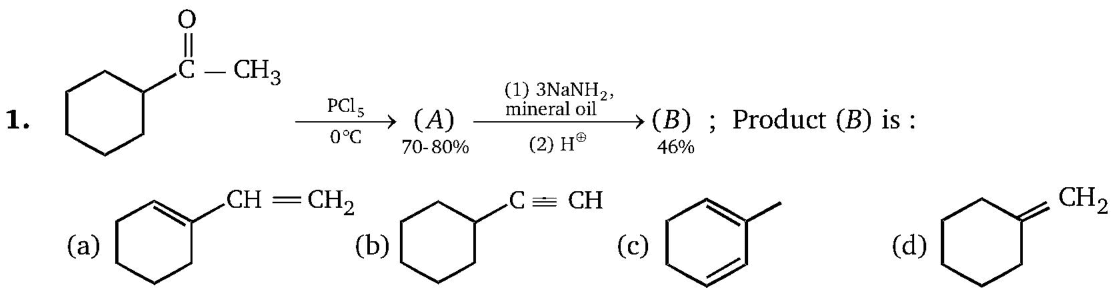
💡 Solution & Explanation
Step 1 – Reaction with PCl5 at 0°C: Cyclohexyl methyl ketone (acetylcyclohexane) reacts with PCl5 (a reagent that converts C=O to CCl2 or, for ketones, gives a geminal dichloride). The ketone C=O is converted to a geminal dichloride: cyclohexyl-CCl2-CH3. This is product (A), a 1,1-dichloroethyl cyclohexane (i.e., 1-(1,1-dichloroethyl)cyclohexane). The yield of 70-80% is consistent with this transformation. Step 2 – Reaction with 3 equivalents of NaNH2 (a strong base/nucleophile) in mineral oil, followed by protonation: NaNH2 is a strong base used in the Ramberg–Bäcklund or, more relevantly here, in the elimination of geminal dihalides to form alkynes (the Corey–Fuchs-type or classical dehydrohalogenation sequence). With a geminal dihalide R-CHCl2 or R-CCl2-R', two equivalents of NaNH2 perform double dehydrohalogenation (E2 twice) to give an alkyne. Starting from cyclohexyl-CCl2-CH3: first elimination gives cyclohexyl-CCl=CH2 (vinyl chloride intermediate), and second elimination gives cyclohexyl-C≡CH (ethynylcyclohexane). The third equivalent of NaNH2 deprotonates the terminal alkyne (pKa ~25) to form the acetylide anion, and subsequent protonation (H+) gives the terminal alkyne back: cyclohexyl-C≡CH, i.e., ethynylcyclohexane. Why other options fail: (a) A vinyl-substituted cyclohexene would require ring modification which does not occur here. (c) Toluene (aromatic) cannot be formed from this substrate under these conditions. (d) Methylenecyclohexane would require elimination within the ring, which is not the pathway here. Product (B) is ethynylcyclohexane (cyclohexylacetylene), which corresponds to option (b). Therefore, the correct answer is B.