See image — Isomerism and Stereochemistry Chemistry Question
Question
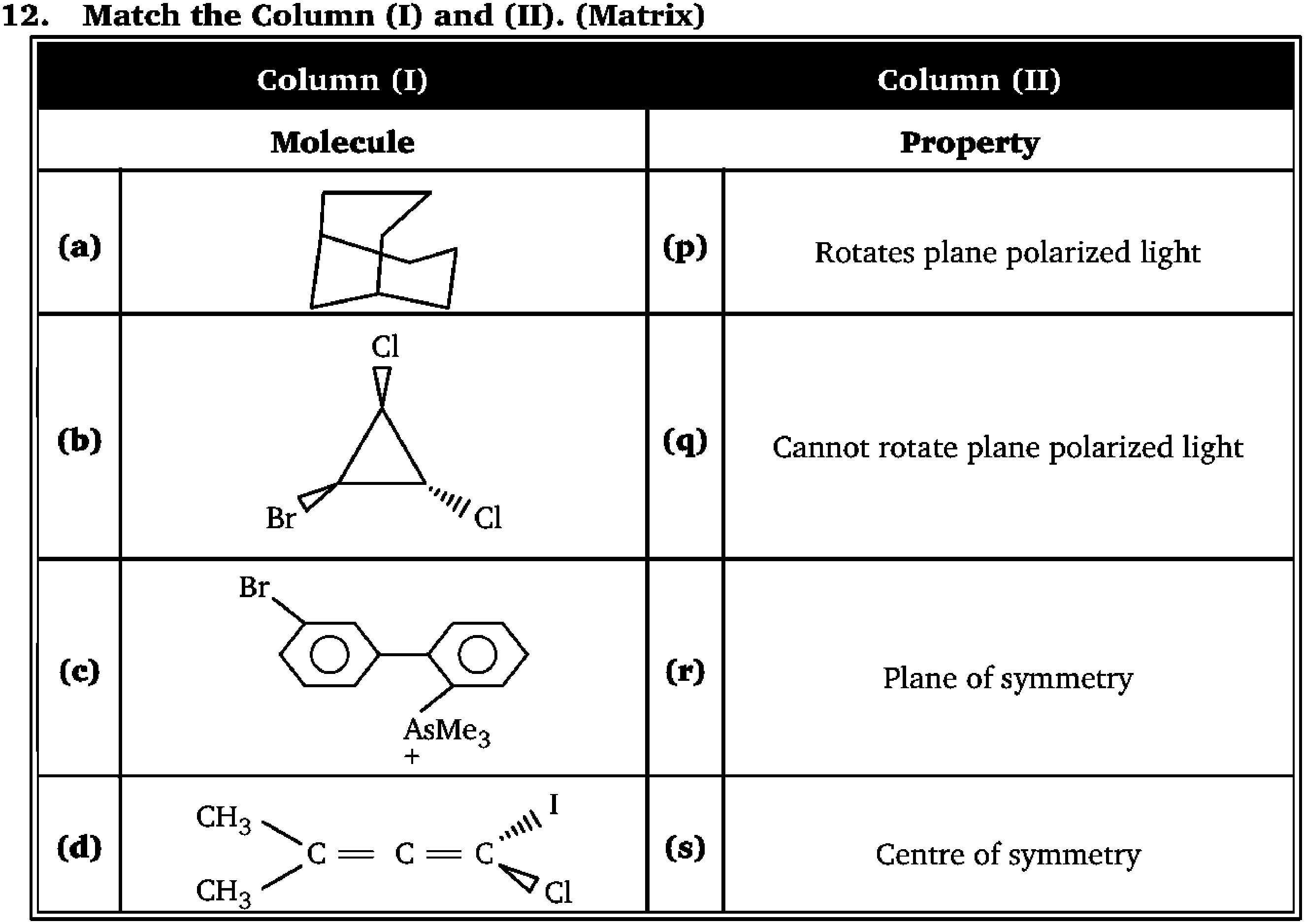
See image
💡 Solution & Explanation
Step 1 - Concept: Optical activity requires a chiral molecule (no plane of symmetry, no centre of symmetry, no improper rotation axis). Achiral molecules cannot rotate plane-polarized light and possess symmetry elements such as a plane or centre of symmetry. Step 2 - Molecule (a): Adamantane is a highly symmetric cage molecule. It belongs to the Td point group and has multiple planes of symmetry and a centre of symmetry equivalent (actually Td has S4 axes). Adamantane is achiral and optically inactive. It possesses planes of symmetry. Therefore (a) matches (q) Cannot rotate plane polarized light and (r) Plane of symmetry. Step 3 - Molecule (b): The cyclopropane shown has three different substituents around the ring - Cl (wedge, C1), Br (wedge, C2), Cl (dash, C3). This is 1-bromo-1,2-dichlorocyclopropane arranged such that all three ring carbons bear different spatial arrangements making the molecule chiral (no plane or centre of symmetry). This is a chiral molecule that exists as a specific enantiomer as drawn. Therefore (b) matches (p) Rotates plane polarized light. Step 4 - Molecule (c): The biphenyl derivative has Br at one ortho position and +AsMe3 at the other ring's ortho position. This is an axially chiral (atropisomeric) biphenyl. With different substituents on each ring (Br on one, AsMe3+ on the other) and restricted rotation, the molecule is chiral (no plane or centre of symmetry). As drawn it is one enantiomer and rotates plane-polarized light. Therefore (c) matches (p) Rotates plane polarized light. Step 5 - Molecule (d): The allene is (CH3)2C=C=C(I)(Cl). For allenes to be chiral, the two ends must each bear two different substituents. Left end: two CH3 groups (same substituents) - this makes the left carbon NOT a chiral allenic terminus (it has two identical groups). Therefore this allene is achiral. Since the left carbon has two identical methyl groups, there is a plane of symmetry (the plane containing CH3, C=C=C, and bisecting the right end). The molecule cannot rotate plane-polarized light and has a plane of symmetry. Therefore (d) matches (q) Cannot rotate plane polarized light and (r) Plane of symmetry. Step 6 - Summary of matches: - (a): achiral, symmetric cage → (q) cannot rotate, (r) plane of symmetry → a-q,r - (b): chiral cyclopropane as drawn → (p) rotates plane polarized light → b-p - (c): axially chiral biphenyl atropisomer → (p) rotates plane polarized light → c-p - (d): allene with two identical groups on one end → achiral → (q) cannot rotate, (r) plane of symmetry → d-q,r Therefore, the correct answer is a-q,r; b-p; c-p; d-q,r.