See image — Reaction Mechanism Chemistry Question
Question
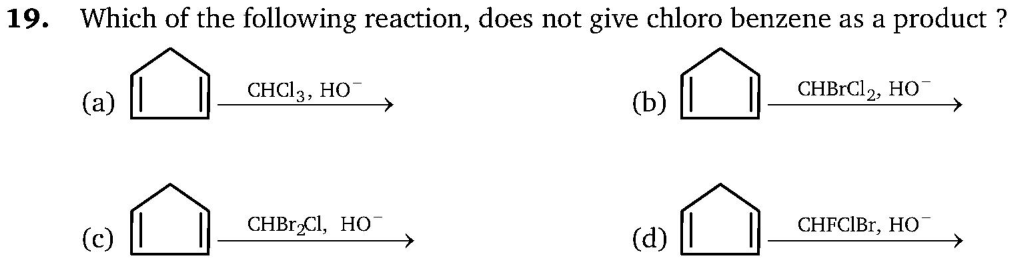
See image
💡 Solution & Explanation
Concept: The Reimer-Tiemann-like carbene insertion or, more relevantly here, the reaction of haloforms (CHX3) or mixed trihalomethanes with strong base (HO-) generates dihalocarbenes (:CX2). When a bicyclic compound such as indane (benzene fused with cyclopentane) reacts with a dihalocarbene under basic conditions, the carbene inserts into the five-membered ring, and subsequent ring expansion or rearrangement can give halogenated benzene derivatives. The key question is which reagent does NOT produce chlorobenzene. Step 1 - Identify the substrate: The substrate in all four options is indane (a benzene ring fused with a cyclopentane ring). Step 2 - Identify the carbene generated in each case: (a) CHCl3 + HO- → :CCl2 (dichlorocarbene). Reaction with the cyclopentane ring of indane, followed by ring expansion, gives chlorobenzene (chlorine is incorporated into the aromatic ring). (b) CHBrCl2 + HO- → :CBrCl (bromochlorocarbene). This carbene contains one Cl, so ring expansion can yield chlorobenzene as a product. (c) CHBr2Cl + HO- → :CBr2 ... wait, re-examining: CHBr2Cl loses HX with HO-. The most acidic proton is removed; the carbene formed is :CBrCl (from loss of Br- or Cl-). Actually CHBr2Cl + HO- → :CBrCl + Br- (or :CBr2 + Cl-). The predominant carbene from CHBr2Cl under basic conditions is :CBrCl (loss of the better leaving group Br-) or predominantly :CBr2 if Cl- leaves. However, since either pathway can give a carbene containing Cl (:CBrCl) or not (:CBr2), ring expansion with :CBrCl gives chlorobenzene, while :CBr2 gives bromobenzene. Chlorobenzene is still a possible product. (d) CHFClBr + HO- → carbene. The carbene generated is :CFCl, :CFBr, or :CClBr depending on which halide leaves. Since F is a very poor leaving group, the carbene formed preferentially is :CClBr (loss of F- is disfavored) or more precisely the base abstracts the proton and then the best leaving group departs. Actually with HO-, deprotonation gives carbanion CHFClBr → [CFClBr]- then loss of the best leaving group. Br- is the best leaving group, giving :CFCl. Then :CFCl contains F and Cl. Ring expansion of indane with :CFCl would give fluorochlorobenzene derivative, NOT chlorobenzene (which requires :CCl2 or a carbene with two Cl, or at least the ring expansion must place Cl in the ring without F). The carbene :CFCl upon ring expansion gives a product where both F and Cl are incorporated, yielding fluorochlorobenzene, not chlorobenzene alone. Since fluorine substitution replaces what would be a chlorine, the product is not chlorobenzene. Step 3 - Why option (d) does not give chlorobenzene: CHFClBr + HO- generates :CFCl (loss of Br-, the best leaving group). The dihalocarbene :CFCl reacts with indane's cyclopentane ring. Ring expansion gives a benzene ring substituted with F and Cl (i.e., fluorochlorobenzene), not chlorobenzene. No reaction pathway from CHFClBr/HO- cleanly produces chlorobenzene because every carbene derived from CHFClBr that contains Cl also contains F or Br, and ring expansion gives mixed halogenated products excluding pure chlorobenzene. Step 4 - Why other options give chlorobenzene: (a) :CCl2 → ring expansion → chlorobenzene (directly). (b) :CBrCl → ring expansion → chlorobenzene (Cl incorporated) or bromobenzene; chlorobenzene is produced. (c) :CBrCl or :CBr2 → at least one pathway gives chlorobenzene. Therefore, the correct answer is D.