See image — Reaction Mechanism Chemistry Question
Question
See image
💡 Solution & Explanation
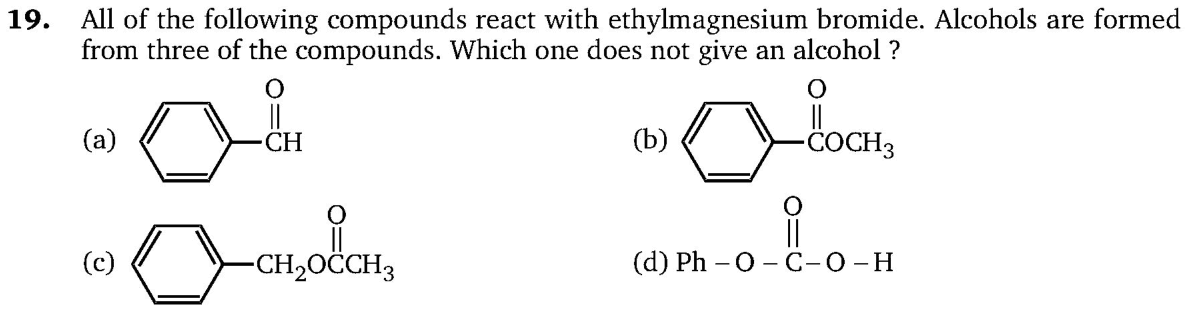
Concept: Grignard reagents (RMgX) react with carbonyl-containing compounds to give alcohols after hydrolysis. However, the type of product depends on the electrophilic carbonyl carbon and whether an alcohol can actually be isolated. Step 1 - Analyze each option with EtMgBr (ethylmagnesium bromide): (a) Benzaldehyde (PhCHO): Grignard addition to an aldehyde gives a secondary alcohol (PhCH(OH)Et) after hydrolysis. -> Gives an alcohol. ✓ (b) Methyl benzoate (PhCOOCH3): Grignard reagents react with esters by double addition. The first addition gives a ketone intermediate (PhCOEt), which reacts with a second equivalent of EtMgBr to give a tertiary alcohol (PhC(OH)(Et)2) after hydrolysis. -> Gives an alcohol. ✓ (c) Benzyl acetate (PhCH2OCOCH3): This is an ester (acetic acid ester of benzyl alcohol). Grignard addition to the ester carbonyl gives, after double addition and hydrolysis, a tertiary alcohol (from the acetyl part: CH3C(OH)(Et)2) plus benzyl alcohol (PhCH2OH) as leaving group product. -> Gives an alcohol. ✓ (d) Ph-O-C(=O)-O-H (phenyl hydrogen carbonate / carbonic acid monophenyl ester): This compound contains a -COOH type group (carbonic acid half ester). When EtMgBr reacts with it, the acidic O-H proton (pKa ~ carboxylic acid range) simply protonates the Grignard reagent, destroying it: R-MgBr + HO- -> R-H + BrMgO-. The Grignard acts as a base rather than a nucleophile. The product formed is ethane (EtH), not an alcohol. No Grignard addition to the carbonyl occurs because the reagent is consumed by the acidic proton first. -> Does NOT give an alcohol from nucleophilic addition. ✗ Step 2 - Why other options give alcohols: Options (a), (b), and (c) all have electrophilic carbonyl carbons without acidic protons that would destroy the Grignard, so nucleophilic addition proceeds and alcohols are obtained after hydrolysis. Step 3 - Why (d) fails: The free hydroxyl group (-OH) in Ph-O-CO-OH is sufficiently acidic to protonate the Grignard reagent before any nucleophilic addition can occur, so no alcohol is produced from the Grignard reaction pathway. Therefore, the correct answer is D.