See image — IUPAC and Nomenclature Chemistry Question
Question
See image
💡 Solution & Explanation
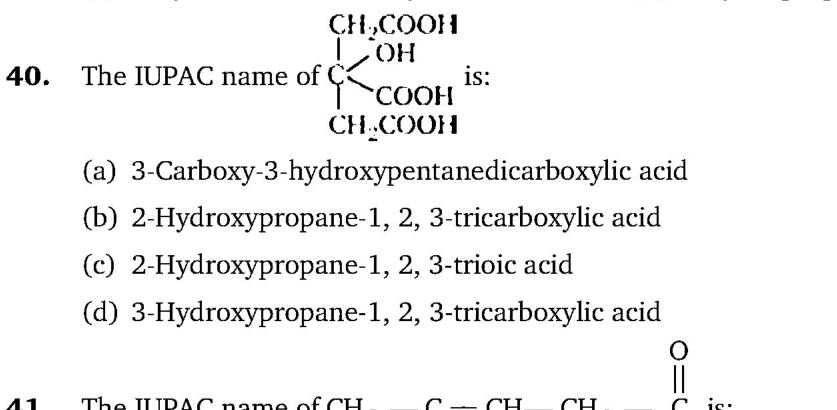
Step 1: Identify the structure. The compound has a central carbon bearing: one -OH group, one -COOH group directly attached, and two -CH2COOH groups. This gives a total of three carboxylic acid groups and one hydroxyl group on the molecule. Step 2: Determine the parent chain. The longest carbon chain that includes the maximum number of -COOH groups must be selected. The three carboxylic acid groups are: one directly on the central carbon and two via -CH2- groups. We select a 3-carbon chain: HOOCCH2-C(OH)(COOH)-CH2COOH. The parent chain is propane with carboxylic acid substituents at C1, C2, and C3 (as -COOH groups), making it a tricarboxylic acid. Step 3: Number the chain. The chain is: C1(=HOOCCH2-), C2(central carbon with OH and COOH), C3(=CH2COOH). The COOH groups at positions 1, 2, and 3 are designated as the tricarboxylic acid suffix. The OH is at position 2. Step 4: Name the compound. Parent chain = propane. Suffix for three -COOH groups = -1,2,3-tricarboxylic acid. The -OH at C2 = 2-hydroxy. Full name: 2-Hydroxypropane-1,2,3-tricarboxylic acid. This is the IUPAC name for citric acid. Step 5: Eliminate incorrect options. (a) '3-Carboxy-3-hydroxypentanedicarboxylic acid' uses pentanedioic acid as parent which is incorrect IUPAC approach here. (c) '2-Hydroxypropane-1,2,3-trioic acid' uses '-trioic acid' suffix which is not standard IUPAC for this structure. (d) '3-Hydroxypropane-1,2,3-tricarboxylic acid' incorrectly places the hydroxy at C3 instead of C2. Therefore, the correct answer is B.