See image — IUPAC and Nomenclature Chemistry Question
Question
See image
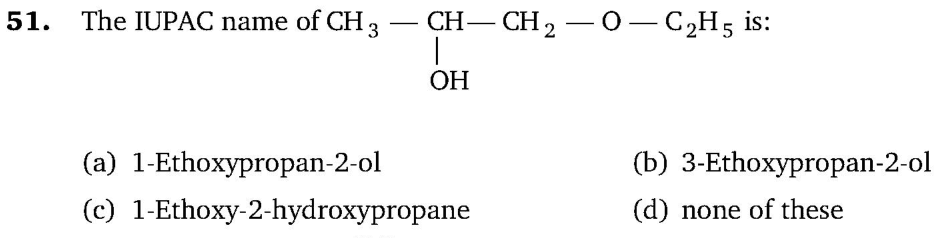
💡 Solution & Explanation
Step 1: Identify the parent chain and functional groups. The compound is CH3-CH(OH)-CH2-O-C2H5. It contains a hydroxyl group (-OH) and an ethoxy group (-O-C2H5). Step 2: Identify the longest carbon chain containing the principal characteristic group (OH). The chain is CH3-CH(OH)-CH2-, which is a 3-carbon (propane) chain. Step 3: Number the chain to give the principal characteristic group (OH) the lowest possible locant. Numbering from the CH3 end: C1=CH3, C2=CH(OH), C3=CH2. Numbering from the other end: C1=CH2, C2=CH(OH), C3=CH3. Both give OH at position 2, but we choose the direction that gives the substituent (ethoxy) the lower locant. From the CH3 end: OH at C2, ethoxy at C3. From the CH2-O end: OH at C2, ethoxy at C1. The direction giving ethoxy at C1 (lower locant) is preferred, so: C1=CH2-O-C2H5, C2=CH(OH), C3=CH3. Step 4: Name the compound. Parent chain = propan-2-ol (OH at C2). Substituent = ethoxy at C1. Full name = 1-Ethoxypropan-2-ol. Step 5: Evaluate other options. Option (b) 3-Ethoxypropan-2-ol is incorrect because it assigns a higher locant (3) to the ethoxy group when a lower locant (1) is possible. Option (c) 1-Ethoxy-2-hydroxypropane is an older substitutive name format that does not follow current IUPAC 2013 recommendations where the principal characteristic group suffix (-ol) must be cited in the name with a locant. Option (d) is incorrect because option (a) is the correct IUPAC name. Therefore, the correct answer is A.