See image — Alcohols Phenols and Ethers Chemistry Question
Question
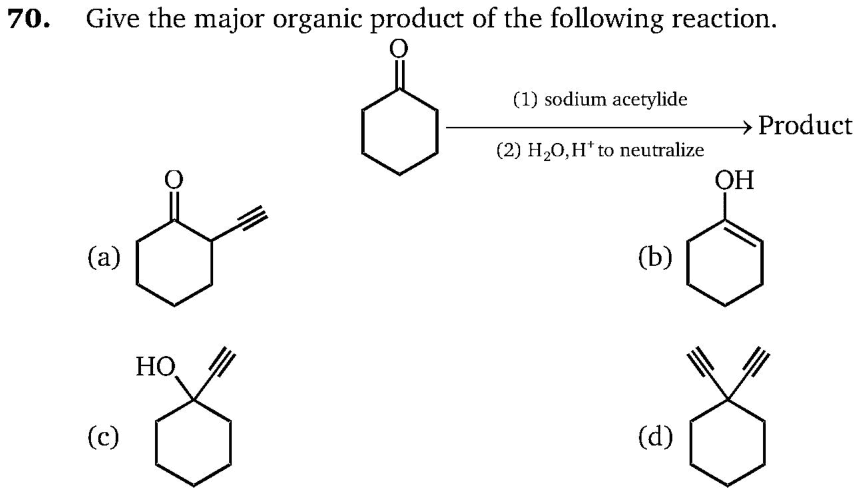
See image
💡 Solution & Explanation
Concept: Sodium acetylide (NaC≡CH) is a strong nucleophile and base. When it reacts with a ketone (nucleophilic addition), the acetylide anion attacks the electrophilic carbonyl carbon. Step 1: Identify the electrophile. Cyclohexanone has a carbonyl (C=O) at C1. The carbonyl carbon is electrophilic. Step 2: Nucleophilic addition of acetylide. The acetylide ion (HC≡C⁻) attacks the carbonyl carbon of cyclohexanone in a nucleophilic addition reaction. This breaks the C=O pi bond, and the oxygen becomes an alkoxide anion. The acetylide carbon forms a new C-C bond with the former carbonyl carbon. Step 3: Protonation. Treatment with H2O and H+ (step 2) protonates the alkoxide to give a tertiary alcohol. Step 4: Product identification. The product is 1-ethynylcyclohexan-1-ol: a cyclohexane ring with both an -OH group and a -C≡CH (ethynyl) group on C1. This is a tertiary propargylic alcohol. This matches option (c). Why other options fail: - (a) shows a cyclohexanone with an ethynyl group alpha to the carbonyl — this would be an alpha-alkylation product, not a nucleophilic addition to the carbonyl. Sodium acetylide under these conditions performs 1,2-addition to the carbonyl, not alpha-substitution. - (b) shows an allylic alcohol (cyclohexenol), which would require elimination or a different reaction pathway. Not consistent with acetylide addition to a simple ketone. - (d) shows 1,1-diethynylcyclohexane with two ethynyl groups and no OH — this would require two equivalents of acetylide and loss of oxygen, which does not occur under these conditions. Therefore, the correct answer is C.