See image — Hydrocarbons Chemistry Question
Question
See image
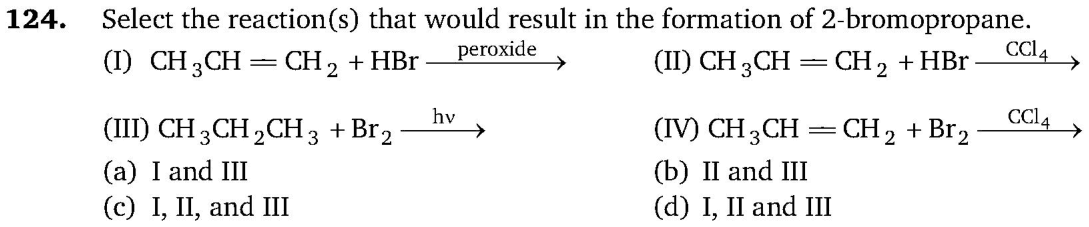
💡 Solution & Explanation
Concept: To form 2-bromopropane (CH3CHBrCH3), bromine must be added to the secondary carbon of propane or propene under appropriate conditions. Analysis of each reaction: Reaction (I): CH3CH=CH2 + HBr with peroxide (anti-Markovnikov conditions) In the presence of peroxide, HBr adds via a free radical mechanism following anti-Markovnikov's rule. The bromine attaches to the terminal (primary) carbon, giving 1-bromopropane (CH3CH2CH2Br), NOT 2-bromopropane. So reaction (I) does NOT give 2-bromopropane. Reaction (II): CH3CH=CH2 + HBr in CCl4 (ionic/Markovnikov conditions) In the absence of peroxide (CCl4 solvent, ionic mechanism), HBr adds following Markovnikov's rule. The H attaches to the terminal carbon (less substituted) and Br attaches to the internal carbon (more substituted), giving CH3CHBrCH3, which is 2-bromopropane. So reaction (II) DOES give 2-bromopropane. Reaction (III): CH3CH2CH3 + Br2 with hv (free radical halogenation) Bromination of propane under light (hv) proceeds via free radical mechanism. Bromine is highly selective and preferentially abstracts the secondary hydrogen (there are 2 secondary H's on C2 vs 6 primary H's on C1 and C3, but bromine's selectivity strongly favors secondary position). The major product is 2-bromopropane (CH3CHBrCH3). So reaction (III) DOES give 2-bromopropane as the major product. Reaction (IV): CH3CH=CH2 + Br2 in CCl4 This is electrophilic addition of Br2 across the double bond, giving 1,2-dibromopropane (CH3CHBrCH2Br), NOT 2-bromopropane. So reaction (IV) does NOT give 2-bromopropane. Conclusion: Only reactions II and III produce 2-bromopropane. Therefore, the correct answer is B.