See image — Alcohols Phenols and Ethers Chemistry Question
Question
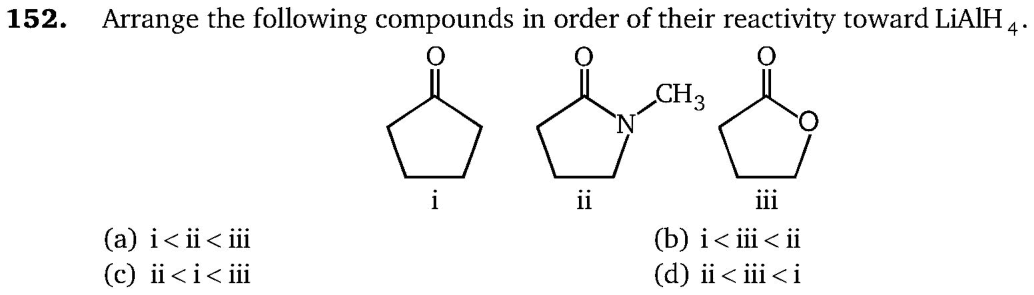
See image
💡 Solution & Explanation
Concept: LiAlH4 reactivity toward carbonyl compounds depends on the electrophilicity of the carbonyl carbon. Greater electrophilicity (more partial positive charge on carbon) leads to higher reactivity toward the hydride nucleophile. Step 1 – Identify the functional groups: - Compound i: cyclopentanone – a simple ketone. The carbonyl carbon is moderately electrophilic. - Compound ii: N-methylpyrrolidin-2-one – a lactam (cyclic amide). The nitrogen lone pair donates into the carbonyl by resonance, significantly reducing the electrophilicity of the carbonyl carbon. Amides are the least reactive carbonyl compounds toward nucleophilic addition. - Compound iii: gamma-butyrolactone – a lactone (cyclic ester). The oxygen lone pair also donates into the carbonyl by resonance, but oxygen is more electronegative than nitrogen, making this donation less effective than nitrogen's donation. Therefore, lactones are more reactive than amides but less reactive than ketones. Step 2 – Rank electrophilicity (and hence LiAlH4 reactivity): - Amide (ii): nitrogen resonance donation is strongest → lowest electrophilicity → least reactive. - Lactone (iii): oxygen resonance donation is moderate → intermediate electrophilicity → intermediate reactivity. - Ketone (i): no resonance donation from heteroatom → highest electrophilicity → most reactive. Step 3 – Order of reactivity: ii < iii < i This matches option (d). Why other options fail: - (a) i < ii < iii: Incorrect; ketones are more reactive than both lactams and lactones. - (b) i < iii < ii: Incorrect; places amide as most reactive, which is wrong. - (c) ii < i < iii: Incorrect; places lactone as most reactive, but ketones are more reactive than lactones. Therefore, the correct answer is D.