See image — Isomerism and Stereochemistry Chemistry Question
Question
See image
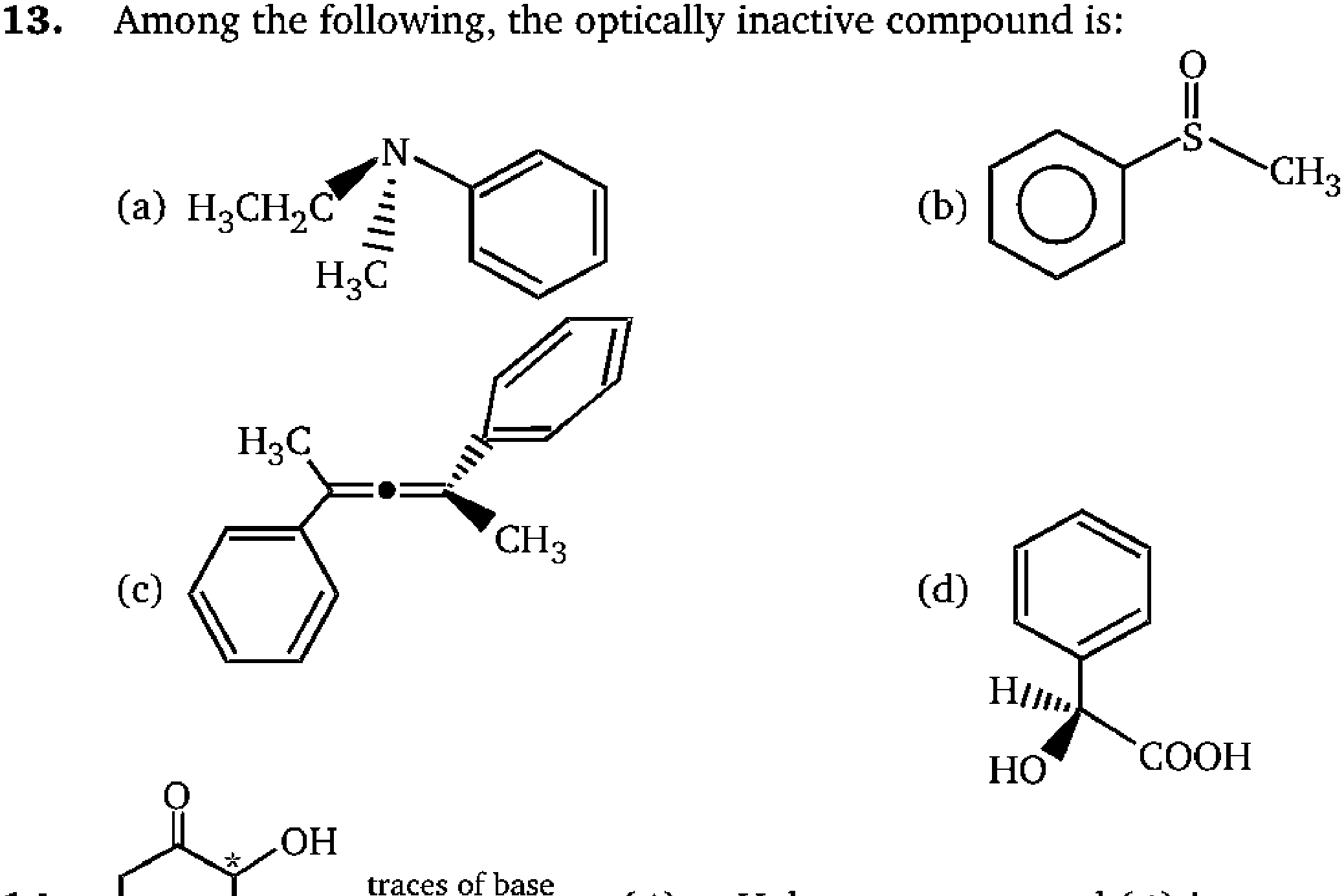
💡 Solution & Explanation
Concept: A compound is optically inactive if it lacks chirality, i.e., it has no chiral centers, no axial chirality, no planar chirality, or if it is a meso compound. Analysis of each option: (a) The nitrogen atom bears three different carbon substituents: ethyl (H3CH2C), methyl (H3C), and phenyl, plus a lone pair. A tertiary amine with three different substituents is technically chiral at nitrogen, but nitrogen inverts rapidly (pyramidal inversion), making it optically inactive in practice at room temperature. However, in the context of this question at the level of structural analysis, this compound has a stereogenic nitrogen but it is typically considered chiral (some questions treat it as chiral). Actually, looking more carefully, this appears to be a quaternary nitrogen or a tertiary amine drawn with wedge/dash - if it is a tertiary amine, rapid inversion makes it optically inactive; but as a drawn structure it is often considered chiral. This option would be optically active if nitrogen inversion is slow, but for amines it is fast. (b) Phenyl methyl sulfoxide has a chiral sulfur center (four different groups: phenyl, methyl, oxygen, and lone pair). This compound IS optically active. (c) The allene shown is (H3C)(C6H5)C=C=C(C6H5)(CH3). For an allene to be chiral (axial chirality), the two ends must each bear two different substituents AND the compound must not be superimposable on its mirror image. Left end: H3C and C6H5 (two different groups - yes). Right end: C6H5 and CH3 (two different groups - yes). However, the key point is whether the substituents on the two ends are the same or different. Left end has {CH3, Ph} and right end has {Ph, CH3} - the same pair of substituents on both ends. When both ends of an allene bear the same pair of substituents (a,b)C=C=C(a,b), the molecule has a plane of symmetry and is optically INACTIVE (it is like a meso-type allene). Specifically, this allene has CH3 and Ph on both carbons of the allene termini, making it achiral due to an internal plane of symmetry. Therefore, compound (c) is optically inactive. (d) The compound shown is mandelic acid (2-hydroxy-2-phenylacetic acid) with defined stereochemistry (H on wedge, OH on bold wedge). This has a chiral center and is optically active. Why (c) is the answer: In allene (c), both terminal carbons bear identical sets of substituents (methyl and phenyl on each end). This creates a plane of symmetry in the molecule, making it achiral and optically inactive, unlike allenes where the two ends bear different substituent pairs. Therefore, the correct answer is C.