See image — Isomerism and Stereochemistry Chemistry Question
Question
See image
💡 Solution & Explanation
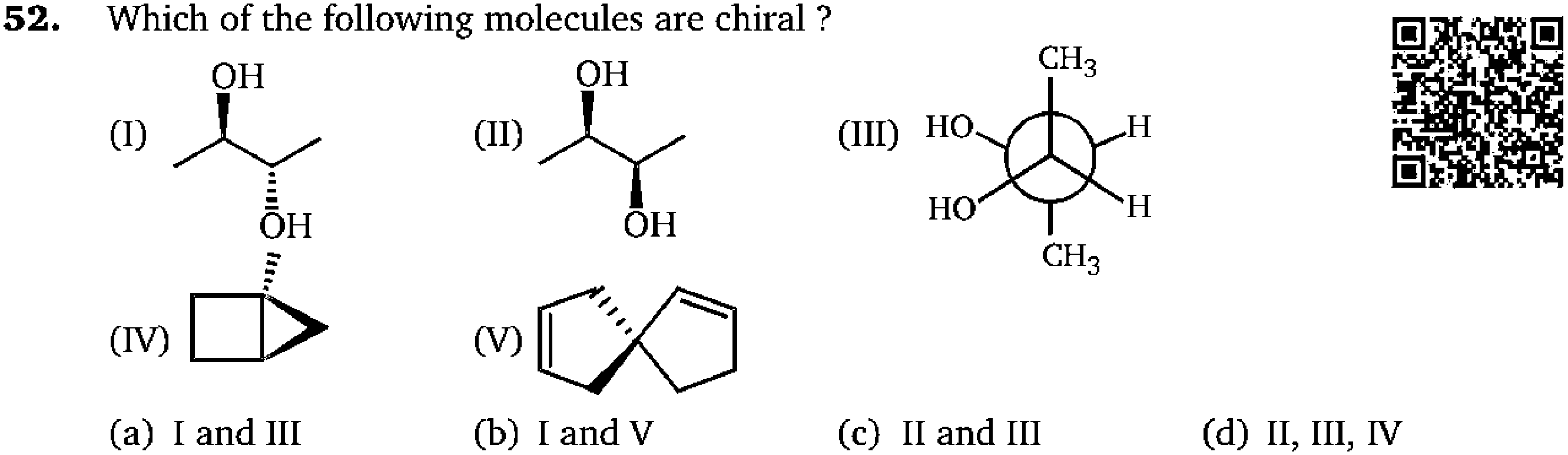
Step 1 — Concept: A chiral molecule is one that is non-superimposable on its mirror image. It lacks an internal plane of symmetry (or any improper rotation axis). A molecule can be chiral due to stereocenters, axial chirality, or planar chirality. Step 2 — Analyze molecule I (butane-2,3-diol, anti/threo diastereomer): Molecule I shows butane-2,3-diol where C2 has OH on a wedge and C3 has OH on a dash. This represents the (2R,3R) or (2S,3S) configuration — the anti diastereomer. Because the two stereocenters have opposite configurations relative to a meso possibility, this is actually the anti (or threo) form. For butane-2,3-diol, the meso form has an internal plane of symmetry (same configuration at both centers in a way that allows superimposition), while the (R,R) and (S,S) forms are chiral. Looking at molecule I: the OH groups are on opposite faces (one wedge up, one dash). This is the anti arrangement: C2(R) and C3(S) or C2(S) and C3(R) — this IS the meso compound (achiral). Wait — re-examining: in butane-2,3-diol, the meso form has one OH up and one OH down (anti), giving an internal mirror plane. The chiral forms are (R,R) and (S,S) where both OHs are on the same face. Molecule I shows one OH wedge and one OH dash = anti = MESO = achiral. Molecule I is NOT chiral. Step 3 — Analyze molecule II (butane-2,3-diol, syn/erythro diastereomer): Molecule II shows both OH groups on wedge bonds (same face). This is the (R,R) or (S,S) configuration of butane-2,3-diol. This diastereomer does NOT have an internal plane of symmetry and is chiral. Molecule II IS chiral. Step 4 — Analyze molecule III (cyclopropane with CH3 and OH substituents): The structure shows a cyclopropane ring with: CH3 at the top carbon, CH3 at the bottom carbon, two OH groups on the left carbon (or one OH each on adjacent carbons on the left), and H atoms on the right. This is 1,2-dimethyl-3,3... Re-reading: the circle representation shows top = CH3, bottom = CH3, left-top = HO, left-bottom = HO, right-top = H, right-bottom = H. This is a 1,2-disubstituted cyclopropane with OH and H on one carbon (upper-left and lower-left being two different carbons), CH3 on top and bottom carbons. The molecule has two stereocenters on the cyclopropane ring. The key question is whether it has an internal mirror plane. Given that both OH groups are on the same side and both CH3 groups are on opposite positions, this molecule lacks a plane of symmetry and is chiral. Molecule III IS chiral. Step 5 — Analyze molecule IV (bicyclobutane with methylene bridge): This is bicyclo[1.1.0]butane with a bold wedge. The molecule appears to be a bicyclic system. Bicyclo[1.1.0]butane itself has a plane of symmetry and is achiral. The bold wedge shown may represent the geometry of the fused ring rather than a stereocenter. This molecule is achiral. Molecule IV is NOT chiral. Step 6 — Analyze molecule V (spiro compound): This is a spiro compound with two five-membered rings. Spiro compounds can be chiral due to axial chirality (spiro chirality) even without classical stereocenters, but only if the two rings are differently substituted. The compound shown appears to be spiro[4.4]nona-1,6-diene or similar, with double bonds in specific positions. If both rings are identical (same substitution pattern), the spiro center is not a stereocenter. From the structure, both rings appear to be cyclopentene rings (with one double bond each), making them identical — thus the molecule has a plane of symmetry and is achiral. Molecule V is NOT chiral. Step 7 — Conclusion: Chiral molecules: II and III. This corresponds to answer choice (c). Why other options fail: - (a) I and III: Molecule I is the meso (achiral) form of butane-2,3-diol. - (b) I and V: Both I and V are achiral. - (d) II, III, IV: Molecule IV (bicyclobutane) is achiral due to molecular symmetry. Therefore, the correct answer is C.