See image — Alcohols Phenols and Ethers Chemistry Question
Question
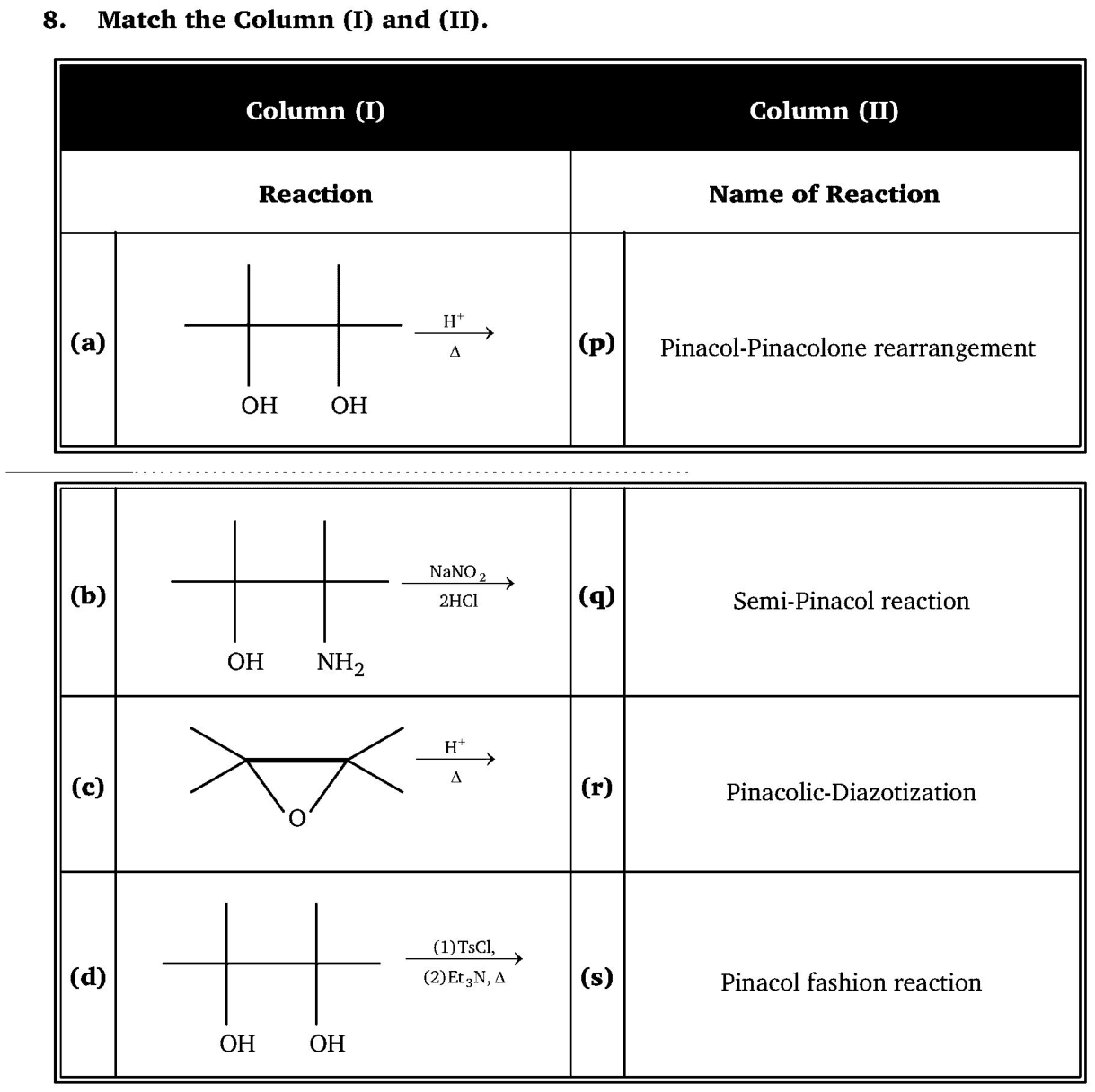
See image
💡 Solution & Explanation
Step 1 – Identify each reaction type: (a) A vicinal diol (pinacol-type: 2,3-dimethyl-2,3-butanediol) treated with acid (H+) and heat undergoes dehydration with a 1,2-methyl shift to give a ketone (pinacolone). This is the classic Pinacol-Pinacolone rearrangement. → matches (p). (b) A vicinal amino alcohol treated with NaNO2/HCl undergoes diazotization of the amine (converting –NH2 to –N2+), followed by 1,2-shift analogous to the pinacol rearrangement (the diazonium leaving group drives migration). This reaction is specifically called Pinacolic-Diazotization (or semi-pinacol via diazotization). → matches (r). (c) A tetramethyl-substituted epoxide (e.g., 2,2,3,3-tetramethyloxirane) treated with H+/heat: acid opens the epoxide to give a carbocation, which then undergoes a 1,2-shift (pinacol-type rearrangement). Because the starting material is an epoxide (not a diol), and the rearrangement proceeds in a pinacol fashion through ring-opening, this is called the Pinacol fashion reaction (epoxide opening leading to rearranged carbonyl). → matches (s). (d) A vicinal diol treated with TsCl (to convert one OH into a tosylate leaving group) then Et3N/heat: the tosylate leaves while the adjacent carbon migrates (1,2-shift), forming a carbonyl compound. This is the Semi-Pinacol reaction (one OH is activated as a leaving group, distinguishing it from the classic pinacol which uses direct protonation). → matches (q). Step 2 – Why other options fail: - (a) cannot be (q) because (q) requires activation of one OH (tosylation), not simple acid protonation. - (b) cannot be (q) or (s) because the NaNO2/HCl specifically converts an amine to a diazonium, which is the defining feature of Pinacolic-Diazotization. - (c) cannot be (p) because (p) requires a diol starting material, not an epoxide. - (d) cannot be (p) because the TsCl/base conditions are characteristic of the semi-pinacol pathway, not simple acid-catalyzed dehydration. Therefore, the correct answer is {"a": ["P"], "b": ["R"], "c": ["S"], "d": ["Q"]}.