See image — Alcohols Phenols and Ethers Chemistry Question
Question
See image
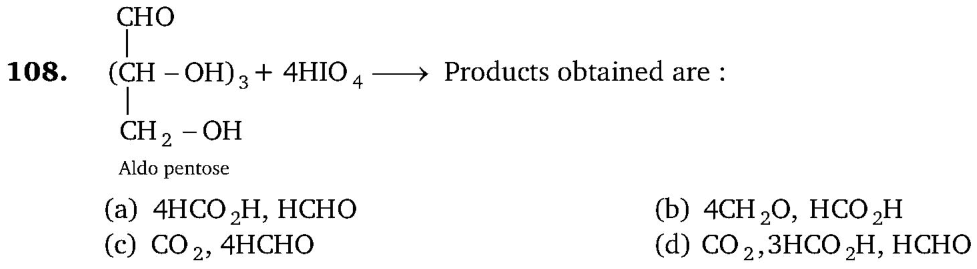
💡 Solution & Explanation
Concept: Periodic acid (HIO4) cleaves vicinal diol (1,2-diol) units oxidatively. Each C-C bond between two carbons bearing OH (or CHO/CH2OH treated as equivalent oxidation states) is cleaved. The products depend on the oxidation state of each carbon: - A terminal -CH2OH gives HCHO (formaldehyde) - An internal -CHOH- gives HCOOH (formic acid) - A terminal -CHO (aldehyde) gives HCOOH (formic acid) Step 1: Write out the aldo pentose structure carbon by carbon: C1: CHO (aldehyde) C2: CHOH C3: CHOH C4: CHOH C5: CH2OH Step 2: Count the number of HIO4 molecules needed. For a straight-chain compound with n carbons and (n-1) vicinal diol/carbonyl-diol pairs, we need (n-1) moles of HIO4. For a pentose: 4 moles of HIO4 (as given). Step 3: Apply cleavage rules to each carbon: - C1 (CHO): aldehyde carbon -> cleaved to give HCOOH (formic acid) - C2 (CHOH): internal -> HCOOH - C3 (CHOH): internal -> HCOOH - C4 (CHOH): internal -> HCOOH - C5 (CH2OH): terminal primary alcohol -> HCHO (formaldehyde) Step 4: Count products: - 4 molecules of HCOOH (HCO2H) from C1, C2, C3, C4 - 1 molecule of HCHO from C5 So products are: 4HCO2H + HCHO Why other options fail: - (b) 4CH2O, HCO2H: incorrect, only the terminal CH2OH gives formaldehyde, not 4 of them - (c) CO2, 4HCHO: incorrect oxidation products assigned - (d) CO2, 3HCO2H, HCHO: CO2 is not a product of periodate cleavage of a simple aldopentose under standard conditions; the aldehyde carbon gives formic acid, not CO2 Therefore, the correct answer is A.