See image — Reaction Mechanism Chemistry Question
Question
See image
💡 Solution & Explanation
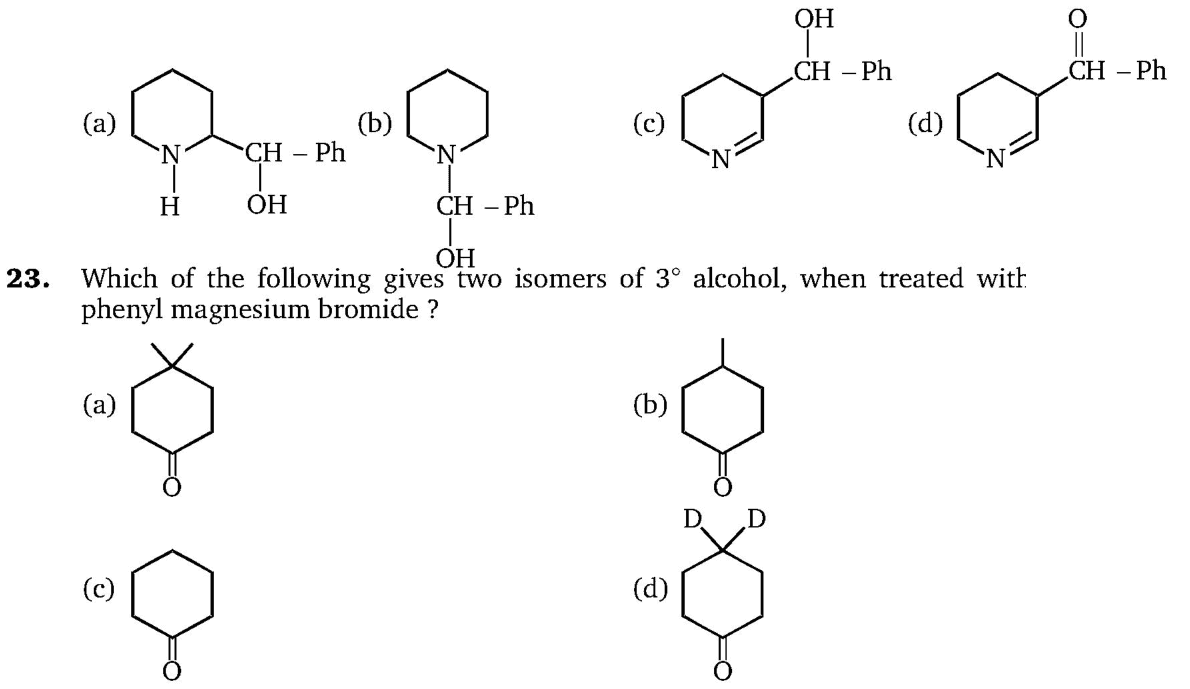
Concept: When a Grignard reagent (PhMgBr) adds to a ketone, it produces a tertiary alcohol. The number of stereoisomers (specifically diastereomers or enantiomers) formed depends on the number of stereocenters created and whether the molecule has any existing symmetry elements or prochiral centers. Step 1 – Analyze option (b): 4-methylcyclohexan-1-one has a methyl substituent at C4. When PhMgBr adds to the carbonyl (C1), C1 becomes a new stereocenter bearing OH, Ph, and two ring carbons. Additionally, C4 already bears a methyl group and is a stereocenter. The molecule has two stereocenters (C1 and C4), so the product can exist as diastereomers. Step 2 – Count isomers for (b): C1 becomes a stereocenter upon Grignard addition. C4 is also a stereocenter (bearing CH3, H, and two different ring carbons once C1 is a stereocenter). The attack of PhMgBr can occur from the axial or equatorial face of the ring, giving two diastereomeric tertiary alcohols: cis-1-phenyl-4-methylcyclohexan-1-ol and trans-1-phenyl-4-methylcyclohexan-1-ol. These are two distinct isomers (diastereomers) of a 3° alcohol. Step 3 – Analyze option (a): 4,4-dimethylcyclohexan-1-one has a gem-dimethyl group at C4. C4 is not a stereocenter (two identical methyl groups). After PhMgBr addition at C1, only one stereocenter is created (C1). The two faces of the carbonyl are enantiotopic (since C4 has two identical methyls, the molecule has a plane of symmetry through C1 and C4). Attack from either face gives enantiomers, not diastereomers. These are a pair of enantiomers (one racemic pair), not two distinguishable isomers in the context of diastereomers. Depending on interpretation, one could argue two enantiomers, but these are not two distinct diastereomers. Step 4 – Analyze option (c): Cyclohexanone is unsubstituted and symmetric. PhMgBr addition creates one stereocenter at C1. Both faces are enantiotopic, giving a racemic mixture of two enantiomers of 1-phenylcyclohexan-1-ol. This is only one pair of enantiomers, not two diastereomers. Step 5 – Analyze option (d): 4,4-dideuterocyclohexan-1-one has two deuterium atoms at C4. C4 with two D atoms is not a conventional stereocenter in the same sense. The two faces of the carbonyl become diastereotopic due to the presence of D at C4 (since D and H are isotopically different, C4 could be considered a pseudostereocenter). Attack from either face of C1 gives two diastereomers. However, deuterium isotope labeling creating stereoisomers is a more subtle case, and the more straightforward and intended answer is (b). Step 6 – Conclusion: Option (b), 4-methylcyclohexan-1-one, clearly gives two diastereomeric 3° alcohols (cis and trans 1-phenyl-4-methylcyclohexan-1-ol) when treated with PhMgBr, because it has an existing stereocenter at C4 and a new one is created at C1. Therefore, the correct answer is B.