See image — Hydrocarbons Chemistry Question
Question
See image
💡 Solution & Explanation
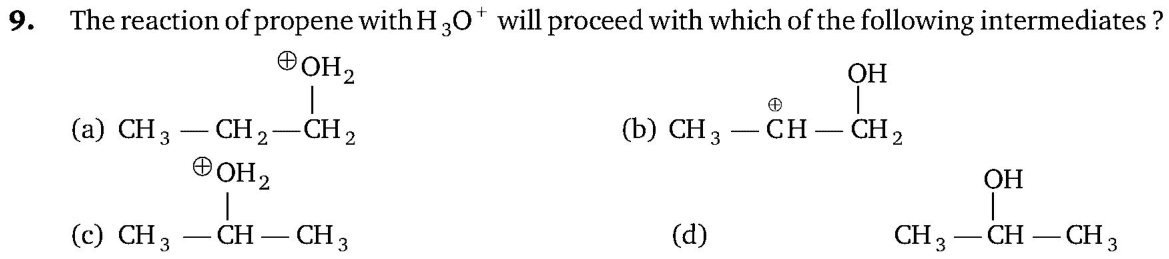
Concept: When an alkene reacts with H3O+ (acid-catalyzed hydration), the mechanism follows Markovnikov's rule. The proton (H+) from H3O+ adds to the double bond carbon that has more hydrogens, generating the more stable carbocation intermediate. Step 1: Identify the substrate. Propene is CH3—CH=CH2. Step 2: Protonation according to Markovnikov's rule. H+ adds to C1 (the =CH2 end, which bears more hydrogens), placing the positive charge on C2 (the secondary carbon), giving the secondary carbocation: CH3—⊕CH—CH3. This is more stable than the primary carbocation CH3—CH2—⊕CH2. Step 3: Identify the intermediate. The carbocation formed is CH3—⊕CH—CH3 (a secondary carbocation on C2). This is a free carbocation intermediate, not yet attacked by water. Step 4: Evaluate the options. (a) Shows a primary carbocation equivalent with ⊕OH2 on terminal carbon — this would imply anti-Markovnikov addition and is less stable; incorrect. (b) Shows a secondary carbocation CH3—⊕CH— with an OH already on the adjacent carbon — this is not the correct intermediate for the first step; incorrect. (c) Shows CH3—CH(⊕OH2)—CH3 — this represents the oxonium ion intermediate formed AFTER the secondary carbocation (CH3—⊕CH—CH3) is attacked by water. This is indeed the correct intermediate in the mechanism: after Markovnikov protonation gives CH3—⊕CH—CH3, water attacks to give CH3—CH(⊕OH2)—CH3, which then loses a proton to give the alcohol. This oxonium ion at the secondary carbon is the key intermediate consistent with Markovnikov's rule and the correct mechanistic pathway. (d) Shows the final product 2-propanol (isopropanol), not an intermediate; incorrect. The reaction proceeds via: propene + H+ → CH3—⊕CH—CH3 → attacked by H2O → CH3—CH(⊕OH2)—CH3 (option c) → loss of H+ → 2-propanol. Therefore, the correct answer is C.