See image — Alcohols Phenols and Ethers Chemistry Question
Question
See image
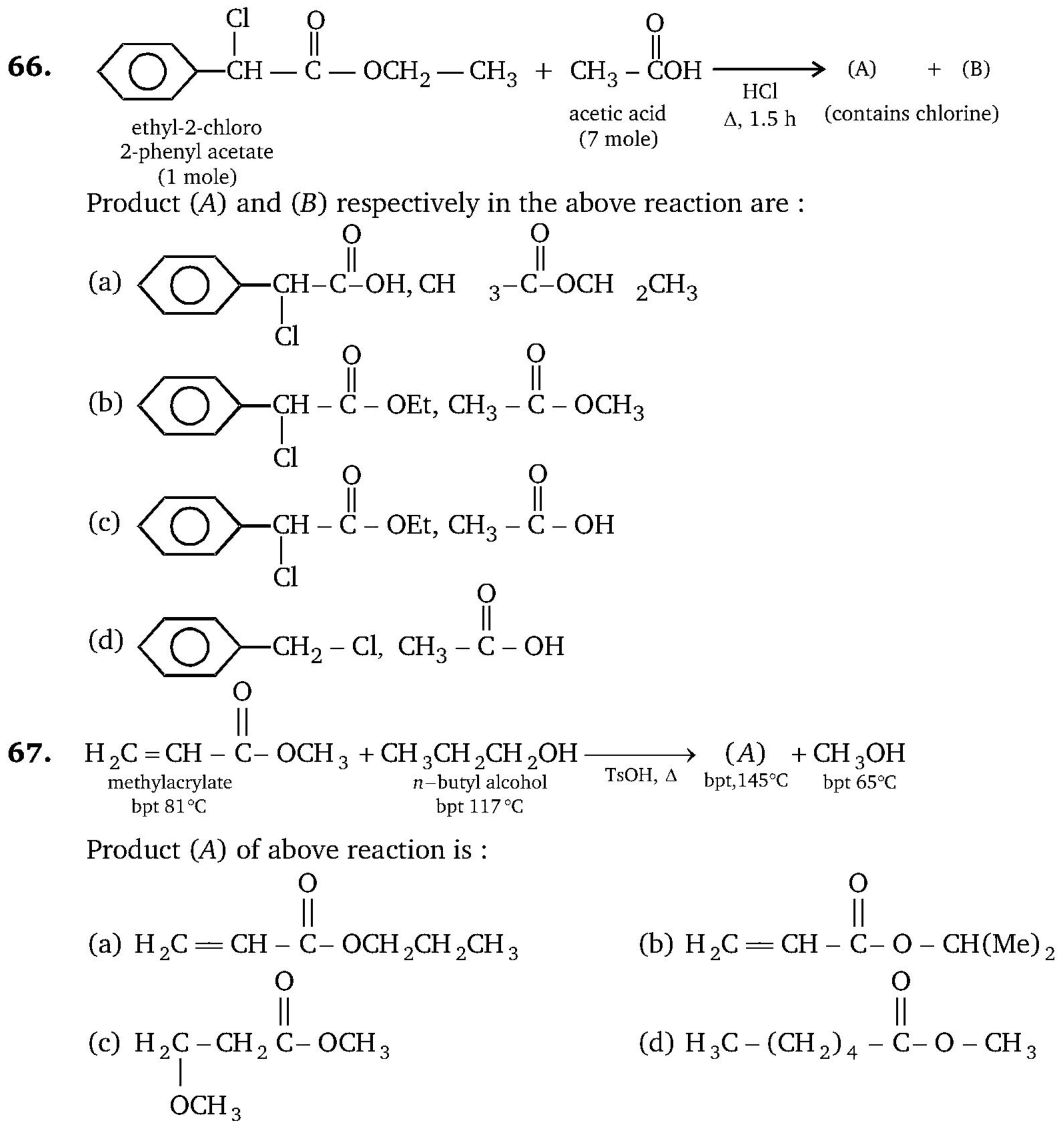
💡 Solution & Explanation
Concept: Transesterification is the exchange of the alkoxy group of an ester with an alcohol, catalyzed by an acid (TsOH) or base, under heating conditions. Step 1: Identify the reaction type. Methylacrylate (H2C=CH-C(=O)-OCH3) reacts with n-butyl alcohol (CH3CH2CH2OH) in the presence of TsOH (acid catalyst) and heat. This is an acid-catalyzed transesterification reaction. Step 2: In transesterification, the -OCH3 group of methylacrylate is replaced by the -OCH2CH2CH3 group from n-butyl alcohol, releasing methanol (CH3OH, bpt 65°C) as the byproduct. Step 3: The product (A) is n-butyl acrylate: H2C=CH-C(=O)-OCH2CH2CH3, boiling point 145°C (consistent with the given bpt for product A). Step 4: Verify with boiling points. Methanol (bpt 65°C) matches the byproduct given. The product A at bpt 145°C is consistent with n-propyl acrylate (n-butyl acrylate has bpt ~145°C), confirming option (a). Step 5: Why other options fail: - Option (b): CH(Me)2 is an isopropyl group, but n-butyl alcohol is a straight-chain primary alcohol, not isopropyl alcohol. - Option (c): This would be a Michael addition product where methanol adds across the double bond, not transesterification; also the double bond would be lost. - Option (d): This would require C-C bond formation or a completely different reaction mechanism, not transesterification. The acid catalyst TsOH specifically promotes transesterification without Michael addition under these conditions, and the driving force is removal of methanol (lower boiling point, 65°C) from the equilibrium. Therefore, the correct answer is A.