See image — IUPAC and Nomenclature Chemistry Question
Question
See image
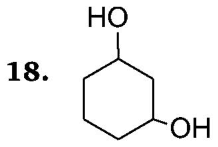
💡 Solution & Explanation
Step 1 (Identify the parent chain/ring): The structure shown is a six-membered carbocyclic ring, so the parent name is cyclohexane. Step 2 (Identify functional groups): There are two hydroxyl (-OH) substituents attached to the ring, making this a diol. The suffix for two -OH groups is -diol. Step 3 (Number the ring to give lowest locants): One -OH is at the top carbon of the ring and the other is two carbons away (meta relationship). Numbering the carbon bearing the first OH as C1, the second OH is on C3, giving locants 1 and 3. Numbering in the opposite direction would also give 1 and 3, so the name is cyclohexane-1,3-diol. Step 4 (Verify): The locant set {1,3} is the lowest possible set for two substituents separated by one carbon on a six-membered ring, confirming the name. No other regioisomeric arrangement (1,2 or 1,4) fits the drawn structure, which clearly shows the two OH groups on carbons separated by one CH2 unit (1,3-positions). Therefore, the correct answer is cyclohexane-1,3-diol.