See image — GOC and Organic Chemistry Basics Chemistry Question
Question
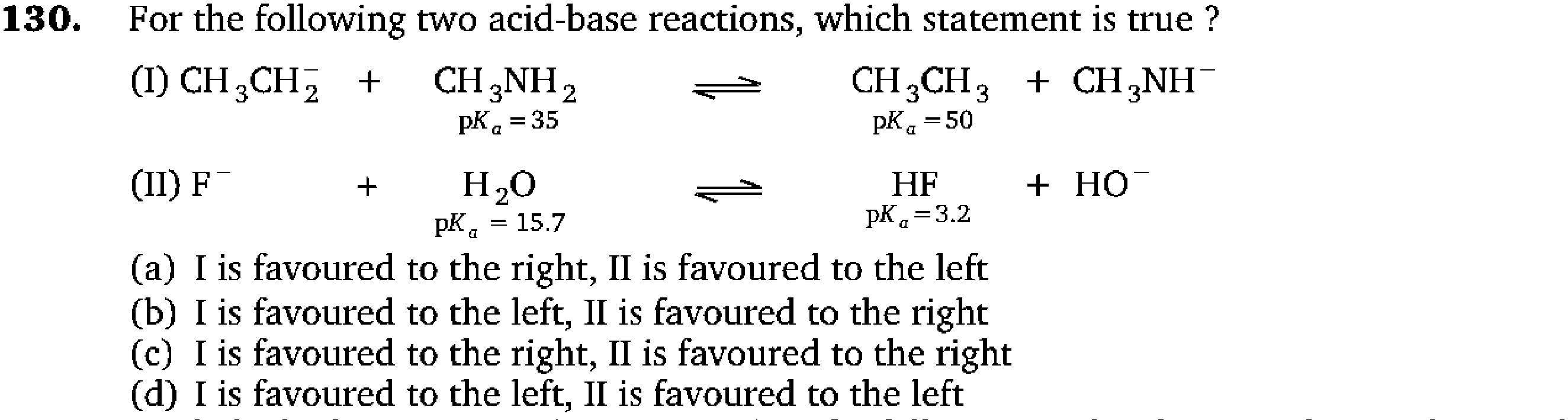
See image
💡 Solution & Explanation
Concept: In an acid-base equilibrium, the reaction is favoured in the direction that goes from the stronger acid to the weaker acid (i.e., from lower pKa to higher pKa on the acid side). Equivalently, Keq = 10^(pKa(acid on left) - pKa(acid on right)); if Keq > 1, reaction favours the right. Reaction I: CH3CH2^- acts as a base accepting a proton from CH3NH2 (pKa = 35) to give CH3CH3 (pKa = 50) + CH3NH^-. The acid on the left (reactant side) is CH3NH2 with pKa = 35. The acid on the right (product side) is CH3CH3 with pKa = 50. Keq = 10^(pKa of reactant acid - pKa of product acid) = 10^(50 - 35) = 10^15, which is much greater than 1. Therefore, Reaction I is strongly favoured to the RIGHT. Reaction II: F^- acts as a base accepting a proton from H2O (pKa = 15.7) to give HF (pKa = 3.2) + HO^-. The acid on the left (reactant side) is H2O with pKa = 15.7. The acid on the right (product side) is HF with pKa = 3.2. Keq = 10^(15.7 - 3.2) = 10^(12.5), which is... wait — but here the product acid HF has a LOWER pKa (stronger acid) than the reactant acid H2O. This means the equilibrium favours the LEFT (reactants), because the reaction proceeds from a weaker acid toward a stronger acid, which is not thermodynamically favoured. Keq = 10^(pKa_reactant_acid - pKa_product_acid) = 10^(15.7 - 3.2) — actually the formula gives Keq = 10^(pKa of acid being deprotonated - pKa of conjugate acid formed). Here pKa of H2O (15.7) minus pKa of HF (3.2) = 12.5, giving Keq = 10^12.5 >> 1, which would favour the right. But this contradicts chemical intuition — HF is a stronger acid than water, so F^- is a weaker base than OH^-, meaning the equilibrium should lie to the LEFT. Re-examining: The correct Keq expression is Keq = Ka(acid on left) / Ka(acid on right) = 10^(-pKa_left) / 10^(-pKa_right) = 10^(pKa_right - pKa_left). For Reaction II: Keq = 10^(pKa_HF - pKa_H2O) = 10^(3.2 - 15.7) = 10^(-12.5) << 1. Reaction II favours the LEFT. For Reaction I: Keq = 10^(pKa_CH3CH3 - pKa_CH3NH2) = 10^(50 - 35) = 10^15 >> 1. Reaction I favours the RIGHT. Summary: Reaction I is favoured to the right; Reaction II is favoured to the left. This matches option (a). Why other options fail: (b) reverses both — incorrect. (c) says both favour right — incorrect for II. (d) says both favour left — incorrect for I. Therefore, the correct answer is A.