See image — Alcohols Phenols and Ethers Chemistry Question
Question
See image
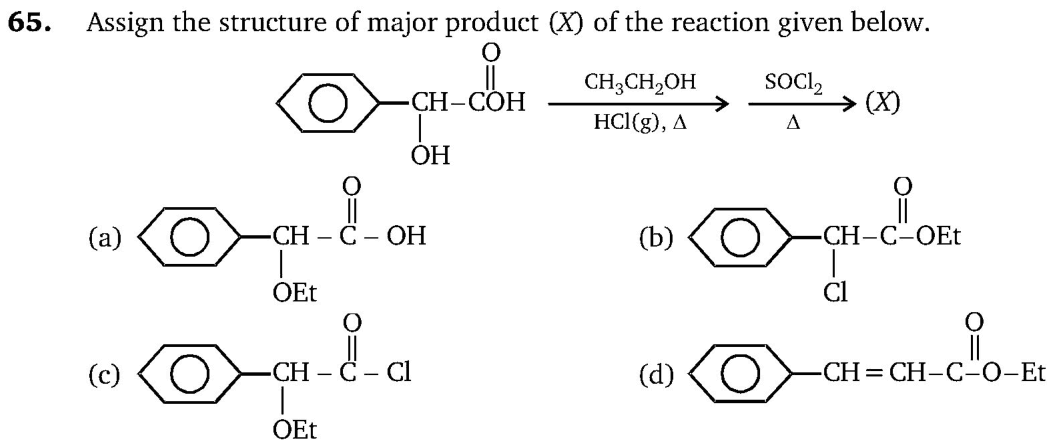
💡 Solution & Explanation
Step 1 - Identify the starting material: The starting material is mandelic acid (alpha-hydroxyphenylacetic acid), which has a benzene ring, a chiral carbon bearing an OH group, and a carboxylic acid (-COOH). Step 2 - First reaction: Treatment with CH3CH2OH (ethanol) and HCl(g) with heat is a Fischer esterification. This converts the carboxylic acid (-COOH) into an ethyl ester (-COOEt). The alcohol (-OH) on the alpha carbon is not affected under these mild esterification conditions. Product of step 1: Benzene ring-CH(OH)-COOEt (ethyl mandelate). Step 3 - Second reaction: Treatment with SOCl2 (thionyl chloride) with heat. SOCl2 is a classic reagent that converts -OH groups into -Cl (chloride) via nucleophilic substitution with inversion or retention depending on mechanism, but the key transformation is OH -> Cl. The ester group (-COOEt) is not reactive toward SOCl2 under these conditions (esters are much less reactive than alcohols or carboxylic acids with SOCl2). Therefore, the alpha-OH is converted to alpha-Cl. Step 4 - Product: Benzene ring-CH(Cl)-C(=O)-OEt, which is ethyl alpha-chlorophenylacetate (ethyl 2-chloro-2-phenylacetate). Step 5 - Evaluate options: (a) Shows OEt on the alpha carbon and free COOH - this would mean esterification occurred at the OH instead of COOH, which is incorrect. (b) Shows Cl on the alpha carbon and COOEt - matches our product exactly. (c) Shows OEt on the alpha carbon and an acid chloride (-COCl) - incorrect, SOCl2 would not selectively convert COOH to COCl after esterification, and the sequence does not support this. (d) Shows an alpha,beta-unsaturated ester with elimination - not the expected product of SOCl2 on an alcohol. Therefore, the correct answer is B.