See image — IUPAC and Nomenclature Chemistry Question
Question
See image
💡 Solution & Explanation
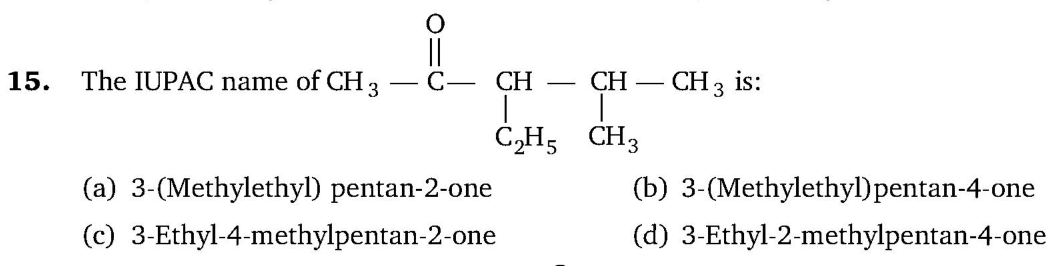
Step 1: Identify the parent chain and functional group. The molecule contains a ketone (C=O). Write out the full carbon skeleton: CH3-C(=O)-CH(C2H5)-CH(CH3)-CH3. The carbonyl carbon is attached to CH3 on one side and a chain continuing through two more carbons ending in CH3 on the other side. Step 2: Find the longest carbon chain containing the ketone. Starting from the terminal CH3 (left of C=O): C1=CH3, C2=C=O, C3=CH(C2H5), C4=CH(CH3), C5=CH3. This gives a 5-carbon (pentane) parent chain with the ketone at position 2, making it pentan-2-one. Step 3: Identify substituents. At C3 there is an ethyl group (C2H5). At C4 there is a methyl group (CH3). Step 4: Number to give lowest locants to substituents and the principal group. Numbering from the end closest to the ketone (left side) gives: ketone at C2, ethyl at C3, methyl at C4. Numbering from the other end would give: ketone at C4, which is higher, so the first numbering is correct. Step 5: Assemble the name. Substituents listed alphabetically: ethyl before methyl. Name: 3-Ethyl-4-methylpentan-2-one. Step 6: Evaluate other options. (a) and (b) use 'methylethyl' (isopropyl) as a combined substituent, which is incorrect because the ethyl and methyl groups are on different carbons. (d) 3-Ethyl-2-methylpentan-4-one would place the ketone at C4, which does not give the lowest possible locant for the principal group. Therefore, the correct answer is C.