See image — Hydrocarbons Chemistry Question
Question
See image
💡 Solution & Explanation
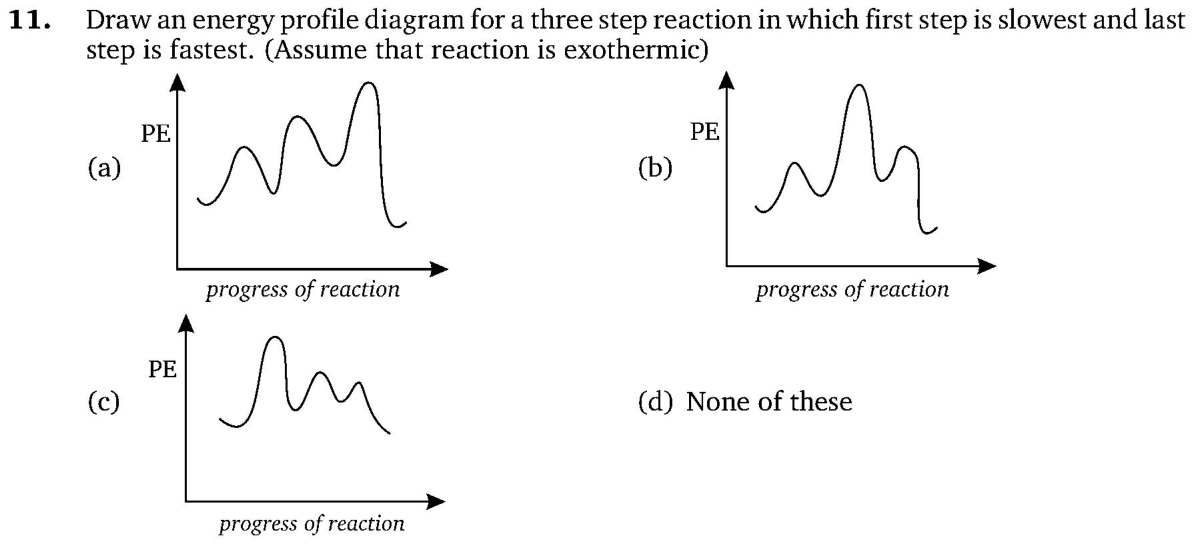
Step 1 - Key Concepts: In an energy profile diagram, the rate of each step is inversely related to its activation energy (Ea). The slowest step has the HIGHEST activation energy barrier (tallest peak), and the fastest step has the LOWEST activation energy barrier (smallest peak). For an exothermic reaction, the products must have lower potential energy than the reactants. Step 2 - Applying the conditions: The reaction has three steps. The first step is the slowest, so the first transition state peak must be the TALLEST. The last (third) step is the fastest, so the third transition state peak must be the SHORTEST. The second step is intermediate in rate, so its peak must be between the first and third in height. This means the peaks decrease in height from left to right: peak 1 > peak 2 > peak 3. Step 3 - Exothermic condition: The overall reaction is exothermic, so the final products must lie at a LOWER potential energy than the initial reactants. Step 4 - Evaluating options: - Option (a): Shows peaks increasing in height from left to right (last peak is tallest), meaning the last step would be slowest, not fastest. Also appears endothermic. Incorrect. - Option (b): Shows the second peak as the highest, not the first. Also the product energy appears lower (exothermic), but the peak ordering is wrong. Incorrect. - Option (c): Shows the first peak as the tallest, with subsequent peaks decreasing in height (first step slowest, last step fastest), and the products are at a lower energy than reactants (exothermic). This matches all conditions. - Option (d): None of these is incorrect since option (c) satisfies all criteria. Therefore, the correct answer is C.