See image — Reaction Mechanism Chemistry Question
Question
See image
💡 Solution & Explanation
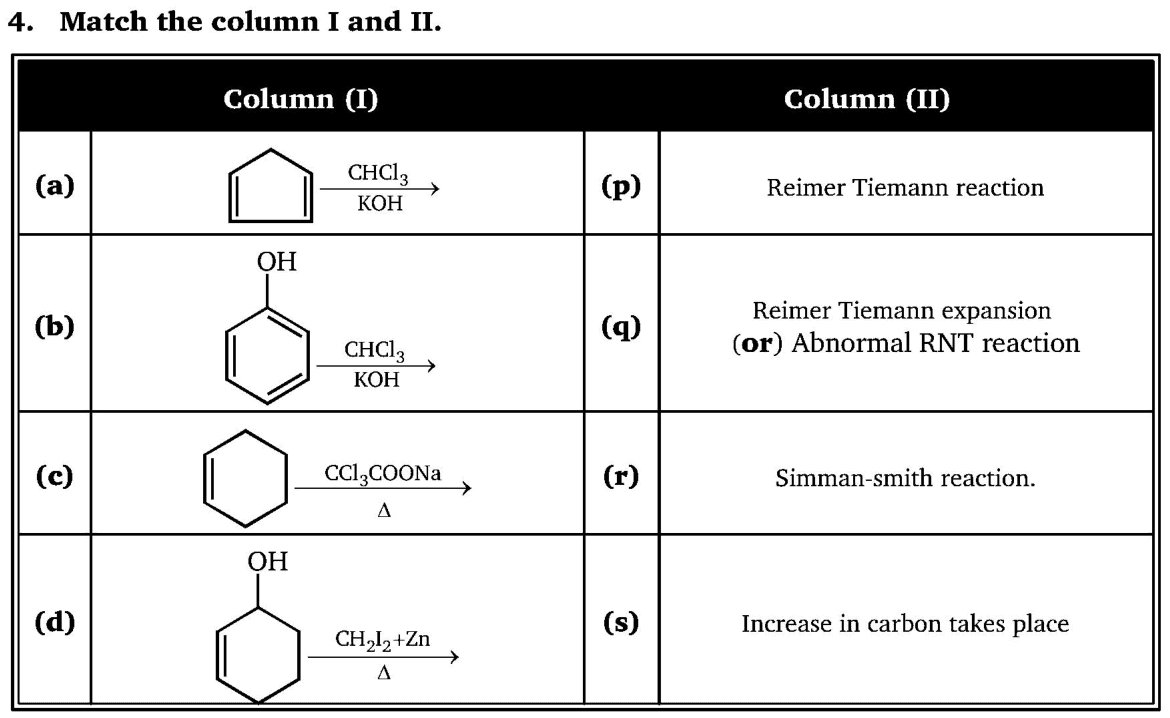
Step 1 - Analyze each reaction in Column I: (a) Cyclopentadiene treated with CHCl3/KOH: Cyclopentadiene is a cyclic diene (not a phenol). When treated with CHCl3/KOH, this is an Abnormal Reimer-Tiemann reaction (also called Reimer-Tiemann expansion or abnormal RNT reaction) because the substrate is a cyclic compound with acidic CH2, not a phenol. The ring expands due to dichlorocarbene insertion, resulting in an increase in the number of carbons. This matches (Q) Reimer Tiemann expansion/Abnormal RNT reaction AND (S) Increase in carbon takes place. So (a) -> Q, S (b) Phenol treated with CHCl3/KOH: This is the classic Reimer-Tiemann reaction. Phenol reacts with CHCl3 in the presence of KOH to give salicylaldehyde (2-hydroxybenzaldehyde). A CHO group (one carbon) is added to the ring, so the number of carbons increases. This matches (P) Reimer Tiemann reaction AND (S) Increase in carbon takes place. So (b) -> P, S (c) Cyclohexene treated with CCl3COONa / heat (Delta): Sodium trichloroacetate (CCl3COONa) upon heating decomposes to generate dichlorocarbene (:CCl2), which adds across the double bond of cyclohexene to form a cyclopropane ring (dichlorocarbene addition). This is a carbene addition reaction. The addition of carbene adds one carbon to the molecule, so carbon count increases. This is not a named Reimer-Tiemann or Simmons-Smith reaction per se, but the reagent generates carbene similar to the carbene addition. However, looking at the options: (R) is Simmons-Smith and (S) is increase in carbon. The CCl3COONa/Delta generates :CCl2 (dichlorocarbene) which adds to the alkene - this increases carbon count (S). The Simmons-Smith reaction uses CH2I2/Zn specifically. So (c) matches only (S). So (c) -> S (d) 2-cyclohexen-1-ol (cyclohexenol) treated with CH2I2 + Zn / Delta: CH2I2 with Zn is the Simmons-Smith reagent, which generates a carbenoid (IZnCH2I) that adds to double bonds to form cyclopropane rings. This is the classic Simmons-Smith reaction. The reaction also increases carbon count by one (the CH2 unit is added). This matches (R) Simmons-Smith reaction AND (S) Increase in carbon takes place. So (d) -> R, S Step 2 - Why other options fail: - (a) cannot be (P) because the substrate is not phenol; it is an abnormal RT reaction. - (b) cannot be (Q) because with phenol the normal Reimer-Tiemann reaction occurs, not the ring-expansion/abnormal variant. - (c) cannot be (R) because CCl3COONa/Delta generates :CCl2 (dichlorocarbene), not the Simmons-Smith carbenoid (IZnCH2I); Simmons-Smith specifically requires CH2I2/Zn. - (d) cannot be (P) or (Q) because no phenol/KOH/CHCl3 conditions are present. Final matching: a -> Q, S b -> P, S c -> S d -> R, S Therefore, the correct answer is {"a": ["Q", "S"], "b": ["P", "S"], "c": ["S"], "d": ["R", "S"]}.