See image — Aldehydes Ketones and Carboxylic Acids Chemistry Question
Question
See image
💡 Solution & Explanation
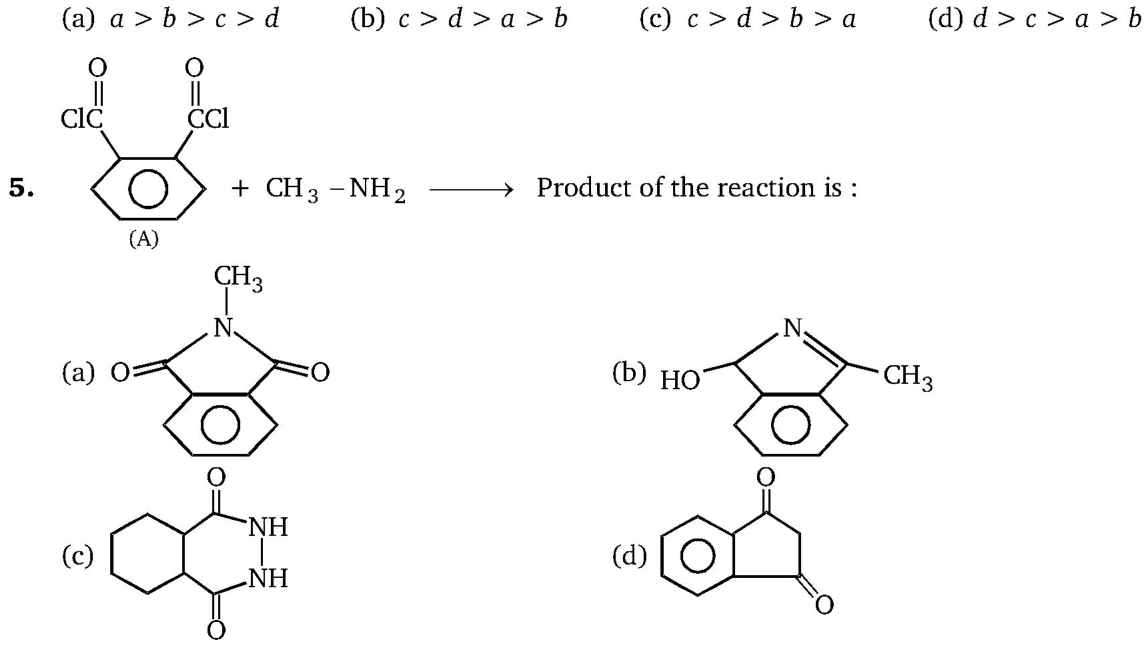
Concept: Reaction of acid chlorides with primary amines to form amides, and intramolecular cyclization to form cyclic imides. Step 1: Identify the reactant (A). Compound (A) is o-phthaloyl dichloride (benzene-1,2-dicarbonyl dichloride), which has two -COCl groups on adjacent (ortho) positions of the benzene ring. Step 2: Identify the reagent. CH3-NH2 is methylamine, a primary amine. Step 3: Reaction mechanism. Each acid chloride (-COCl) reacts with methylamine (CH3NH2). The first -COCl reacts with CH3NH2 to form an amide bond (-CO-NH-CH3), releasing HCl. Since the nitrogen now has one H remaining (it was CH3-NH2, so after first acylation it becomes -CO-N(CH3)-H), it can react intramolecularly with the second -COCl group on the adjacent carbon. This second cyclization releases another HCl and forms a five-membered cyclic imide ring with N-CH3. Step 4: Product identification. The product is N-methylphthalimide: a five-membered imide ring (with N-CH3 and two C=O groups) fused to the benzene ring. This matches option (a). Why other options fail: - Option (b): Shows an imine/oxazole-type product with an OH group, which is not consistent with the reaction of two acid chlorides with a primary amine. - Option (c): Shows a six-membered ring with two NH groups, which would be the product with hydrazine (NH2-NH2), not methylamine. - Option (d): Shows phthalic anhydride (two C=O bridged by oxygen), which would require an oxygen nucleophile, not an amine. Therefore, the correct answer is A.