See image — Hydrocarbons Chemistry Question
Question
See image
💡 Solution & Explanation
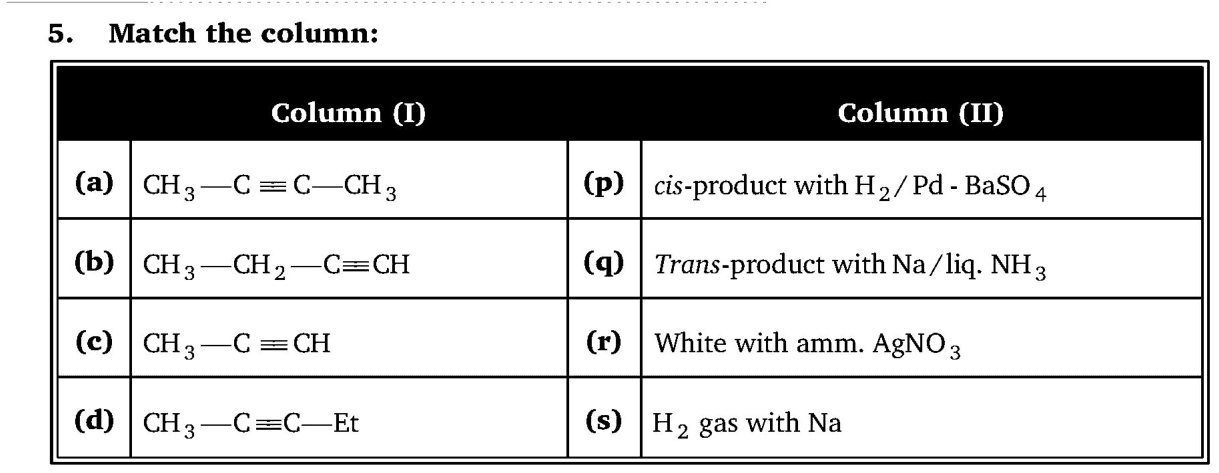
Step 1: Identify the nature of each alkyne in Column (I). (a) CH3-C≡C-CH3 is 2-butyne, an internal alkyne (no terminal H on the triple bond). (b) CH3-CH2-C≡CH is 1-butyne, a terminal alkyne (has an acidic H on the triple bond carbon). (c) CH3-C≡CH is propyne, a terminal alkyne (has an acidic H on the triple bond carbon). (d) CH3-C≡C-Et (Et = C2H5) is 2-pentyne, an internal alkyne (no terminal H on the triple bond). Step 2: Analyze each reaction in Column (II). (p) cis-product with H2/Pd-BaSO4 (Lindlar's catalyst): This is syn-addition of H2 giving the cis-alkene. This requires an internal alkyne (needs two carbon substituents on both sides of the triple bond to give a geometric isomer). Terminal alkynes give only one product (monosubstituted alkene) that is not strictly 'cis'. So this applies to internal alkynes: (a) and (d). (q) Trans-product with Na/liq. NH3 (Birch reduction / dissolving metal reduction): This gives the trans-alkene via anti addition. Again, this requires an internal alkyne to produce a distinguishable trans-alkene. Applies to internal alkynes: (a) and (d). (r) White precipitate with ammoniacal AgNO3: Terminal alkynes react with Ag(NH3)2+ to form a white/pale yellow silver acetylide precipitate. This applies only to terminal alkynes: (b) and (c). (s) H2 gas with Na: Terminal alkynes have an acidic C-H (pKa ~25) that reacts with Na metal to liberate H2 gas (just as alcohols do with Na). This applies only to terminal alkynes: (b) and (c). Step 3: Compile the matches. (a) CH3-C≡C-CH3 (internal) → (p) cis-product with H2/Pd-BaSO4, (q) Trans-product with Na/liq. NH3 (b) CH3-CH2-C≡CH (terminal) → (r) White with amm. AgNO3, (s) H2 gas with Na (c) CH3-C≡CH (terminal) → (r) White with amm. AgNO3, (s) H2 gas with Na (d) CH3-C≡C-Et (internal) → (p) cis-product with H2/Pd-BaSO4, (q) Trans-product with Na/liq. NH3 Why other options fail: - Terminal alkynes (b, c) cannot give a true cis/trans pair from H2/Pd-BaSO4 or Na/liq. NH3 because they produce only a monosubstituted alkene without geometric isomerism at that carbon. - Internal alkynes (a, d) do not have a terminal acidic H, so they do not form silver acetylide precipitates or liberate H2 with Na. Therefore, the correct answer is {"a": ["P", "Q"], "b": ["R", "S"], "c": ["R", "S"], "d": ["P", "Q"]}.