See image — Hydrocarbons Chemistry Question
Question
See image
💡 Solution & Explanation
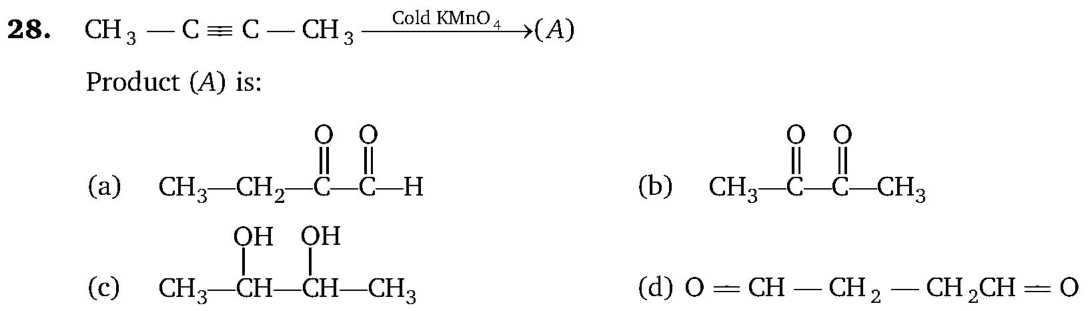
Concept: Cold KMnO4 (dilute, alkaline, cold potassium permanganate) is a mild oxidizing agent used for syn-dihydroxylation of alkenes and, for alkynes, it converts the triple bond to an alpha-diketone (or diol depending on conditions). Step 1: Identify the starting material. CH3-C≡C-CH3 is but-2-yne, a symmetrical internal alkyne. Step 2: Determine the reaction of alkynes with cold KMnO4. Cold, dilute KMnO4 oxidizes internal alkynes to alpha-diketones (1,2-diketones). The two carbons of the triple bond each gain an oxygen, forming a C=O on each carbon. Step 3: Apply to but-2-yne. CH3-C≡C-CH3 + cold KMnO4 → CH3-C(=O)-C(=O)-CH3, which is butane-2,3-dione (biacetyl), a 1,2-diketone. Step 4: Match to options. - Option (a): CH3-CH2-C(=O)-C(=O)-H is a different carbon skeleton (aldehyde + ketone), not formed here. - Option (b): CH3-C(=O)-C(=O)-CH3 is butane-2,3-dione, which matches the expected product. - Option (c): CH3-CH(OH)-CH(OH)-CH3 is the diol product that would form from an alkene with cold KMnO4, not from an alkyne. - Option (d): O=CH-CH2-CH2CH=O is succinaldehyde, an entirely different compound with a different carbon skeleton. Therefore, the correct answer is B.