See image — Alcohols Phenols and Ethers Chemistry Question
Question
See image
💡 Solution & Explanation
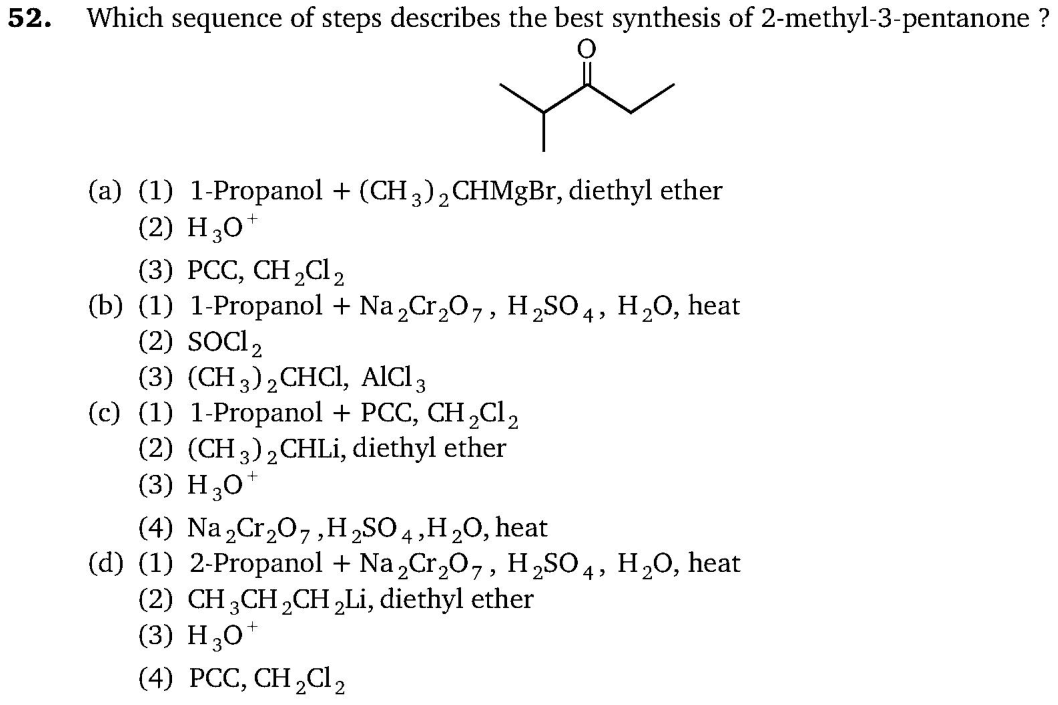
Step 1 - Identify the target molecule: 2-methyl-3-pentanone has the structure (CH3)2CH-CO-CH2CH3. This is a ketone with an isopropyl group on one side and an ethyl group on the other side of the carbonyl. Step 2 - Retrosynthetic analysis: One logical disconnection is to break the C-C bond between the carbonyl carbon and the isopropyl group. This suggests forming the ketone from a secondary alcohol intermediate: (CH3)2CH-CHOH-CH2CH3 (2-methyl-3-pentanol), which upon oxidation gives the target ketone. Alternatively, disconnect at the other side to get propanal + isopropyl nucleophile. Step 3 - Analyze option (c): - Step (1): 1-Propanol (CH3CH2CH2OH) + PCC, CH2Cl2 → propanal (CH3CH2CHO). PCC oxidizes a primary alcohol to an aldehyde without over-oxidizing to carboxylic acid. - Step (2): Propanal + (CH3)2CHLi (isopropyllithium), diethyl ether → lithium alkoxide intermediate. The organolithium reagent acts as a nucleophile, adding the isopropyl carbanion to the aldehyde carbonyl to give a lithium alkoxide of 2-methyl-3-pentanol. - Step (3): H3O+ → protonation gives 2-methyl-3-pentanol (a secondary alcohol). - Step (4): Na2Cr2O7, H2SO4, H2O, heat → oxidizes the secondary alcohol to the ketone, giving 2-methyl-3-pentanone. This sequence is clean and logical: primary alcohol → aldehyde → addition of isopropyl nucleophile → secondary alcohol → ketone. Step 4 - Why other options fail: - Option (a): Adding a Grignard reagent (isopropylmagnesium bromide) to 1-propanol directly does not work because Grignard reagents are destroyed by alcohols (proton transfer). The alcohol must first be converted to an aldehyde. Also PCC after Grignard addition would give a ketone from secondary alcohol, but step (1) is invalid. - Option (b): Oxidizing 1-propanol with Na2Cr2O7 gives propionic acid (not an acid chloride precursor to use in Friedel-Crafts), and Friedel-Crafts acylation is not applicable here for making aliphatic ketones in this manner; this does not give 2-methyl-3-pentanone. - Option (d): Starting with 2-propanol, oxidizing to acetone (a ketone), then adding propyllithium gives a tertiary alcohol (2-methyl-2-pentanol after workup), not a secondary alcohol. PCC cannot oxidize a tertiary alcohol. This does not yield the target. Therefore, the correct answer is C.