See image — Aldehydes Ketones and Carboxylic Acids Chemistry Question
Question
See image
💡 Solution & Explanation
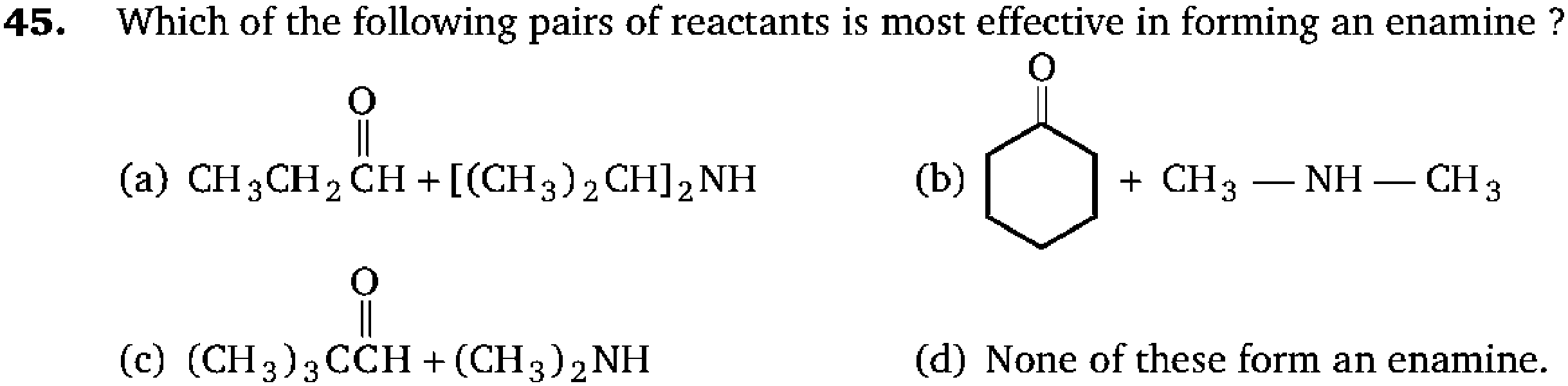
Concept: Enamines are formed by the reaction of a carbonyl compound (aldehyde or ketone) with a secondary amine, followed by loss of water. Two structural requirements are critical: (1) the amine must be secondary (R2NH) to give an enamine rather than an imine, and (2) the carbonyl carbon must have at least one alpha-hydrogen so that after the hemiaminal forms, dehydration can occur to give the C=C-N system. Analysis of each option: Option (a): CH3CH2CHO (propanal) + [(CH3)2CH]2NH (diisopropylamine). The amine is secondary, which is correct. Propanal has alpha-hydrogens. However, diisopropylamine is extremely sterically hindered (two isopropyl groups on nitrogen), making nucleophilic attack on the carbonyl very difficult. This pair is poor for enamine formation due to steric hindrance of the amine. Option (b): Cyclohexanone + CH3-NH-CH3 (dimethylamine). Cyclohexanone is a cyclic ketone with alpha-hydrogens on both sides of the carbonyl, making it highly reactive toward enamine formation. Dimethylamine is a secondary amine that is small and unhindered, making it an excellent nucleophile. The combination of a reactive ketone (cyclic, with readily available alpha-H) and an unhindered secondary amine is ideal for enamine formation. This is the classic and most effective combination. Option (c): (CH3)3CCHO (pivaldehyde, trimethylacetaldehyde) + (CH3)2NH (dimethylamine). The amine is secondary and unhindered. However, pivaldehyde has NO alpha-hydrogens (the alpha carbon is the quaternary carbon bearing three methyl groups and no H). Without an alpha-hydrogen, the hemiaminal intermediate cannot dehydrate to form the enamine C=C bond. Therefore, no enamine can form. Option (d): Incorrect, because option (b) clearly can form an enamine. Conclusion: Option (b) satisfies both requirements perfectly — a ketone with alpha-hydrogens (cyclohexanone) and an unhindered secondary amine (dimethylamine) — making it the most effective pair for enamine formation. Therefore, the correct answer is B.