See image — Reaction Mechanism Chemistry Question
Question
See image
💡 Solution & Explanation
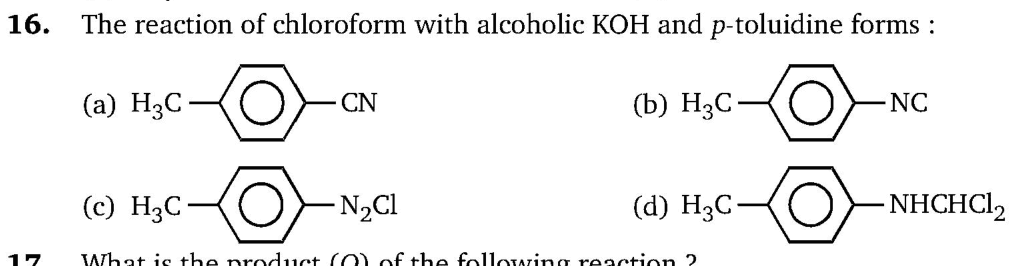
Concept: The carbylamine reaction (isocyanide test) involves the reaction of a primary amine with chloroform (CHCl3) in the presence of alcoholic KOH to form an isocyanide (isonitrile, R-NC). Step 1: Identify the reagents. Chloroform (CHCl3) + alcoholic KOH + p-toluidine (a primary aromatic amine, H3C-C6H4-NH2, para substituted). Step 2: Mechanism of carbylamine reaction. Alcoholic KOH dehydrohalogenates CHCl3 to generate dichlorocarbene (:CCl2). The primary amine (p-toluidine) attacks the dichlorocarbene, and subsequent elimination of two HCl molecules (aided by KOH) yields the isocyanide product R-NC. Step 3: The product is p-tolyl isocyanide: H3C-[benzene ring]-NC. The functional group is isocyanide (-NC), where nitrogen is bonded to carbon of the ring and carbon is the terminal atom. Step 4: Why other options fail: - Option (a) H3C-C6H4-CN is a nitrile (cyanide), not formed in this reaction; nitriles are formed from different reactions (e.g., nucleophilic substitution with CN-). - Option (c) H3C-C6H4-N2Cl is a diazonium salt, formed by diazotization (NaNO2/HCl), not from CHCl3/KOH. - Option (d) H3C-C6H4-NHCHCl2 would be a simple N-alkylation intermediate, but under alkaline conditions this further eliminates to give isocyanide; it is not the final product. The carbylamine reaction specifically converts primary amines to isocyanides (R-NC), making option (b) correct. Therefore, the correct answer is B.