See image — Hydrocarbons Chemistry Question
Question
See image
💡 Solution & Explanation
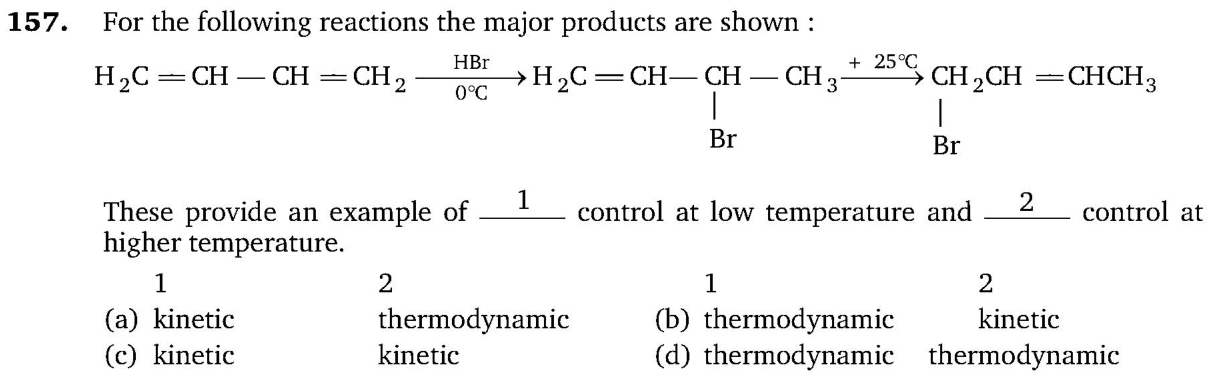
Concept: When 1,3-butadiene reacts with HBr, two products are possible via 1,2-addition and 1,4-addition. The reaction proceeds through a resonance-stabilized allylic carbocation intermediate. Step 1 - Identify the two products: - At low temperature (0°C), the major product is the 1,2-addition product: H2C=CH-CH(Br)-CH3. This is the kinetic product because it forms faster (lower activation energy, Br- attacks the more accessible adjacent carbon). - At higher temperature (25°C), the major product is the 1,4-addition product: BrCH2-CH=CH-CH3. This is the thermodynamic product because it is more stable (the internal double bond CH=CH is more stable than the terminal double bond CH=CH2, and the product has more substituted alkene). Step 2 - Kinetic vs. Thermodynamic control: - Kinetic control: The reaction is governed by the rate of formation (lower activation energy path). At low temperatures, there is not enough thermal energy to overcome the higher activation energy barrier leading to the more stable product, so the faster-forming (kinetic) product predominates. - Thermodynamic control: At higher temperatures, the reaction is reversible and equilibrium favors the more stable (thermodynamic) product. The system has enough energy to reach the more stable product. Step 3 - Match to blanks: - Blank 1 (low temperature, 0°C) = kinetic control - Blank 2 (higher temperature, 25°C) = thermodynamic control Step 4 - Why other options fail: - (b) reverses the assignment, calling low temperature thermodynamic and high temperature kinetic, which is incorrect. - (c) calls both kinetic, ignoring that higher temperature leads to thermodynamic control. - (d) calls both thermodynamic, ignoring that low temperature gives kinetic control. Therefore, the correct answer is A.