See image — Isomerism and Stereochemistry Chemistry Question
Question
See image
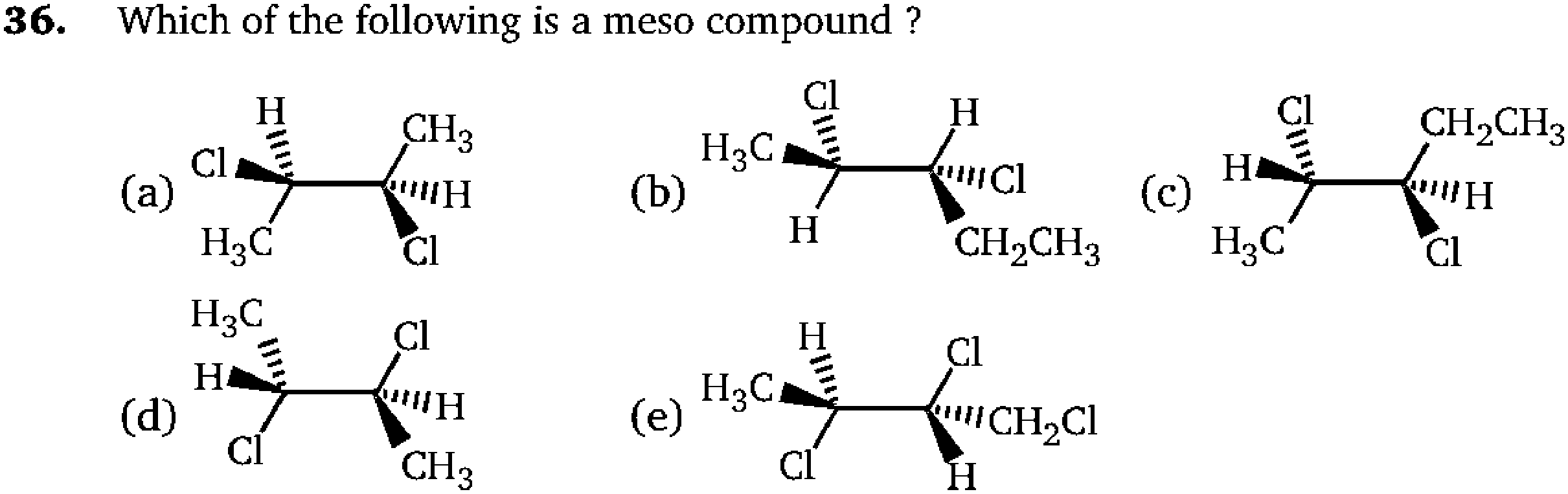
💡 Solution & Explanation
A meso compound is a molecule that has stereocenters but is achiral overall due to an internal plane of symmetry. It has the same connectivity and substituents at each stereocenter but the configuration at one center is the mirror image of the other (one R and one S), making the molecule superimposable on its mirror image. Step 1 - Identify the compound type for option (d): Option (d) shows a 2,3-dichlorobutane structure. The molecule is: CH3-CHCl-CHCl-CH3. This compound has two stereocenters (C2 and C3), each bearing H, Cl, CH3, and the adjacent CHClCH3 group. Step 2 - Determine configurations at each stereocenter in (d): In structure (d): Left carbon has H3C on wedge (coming toward viewer, up), H on bold/solid bond (coming toward viewer, left), and Cl on plain bond (going back, down). Right carbon has Cl on plain bond (up-right), H on dashed wedge (going away), and CH3 on bold bond (down). Analyzing the spatial arrangement, the two stereocenters have opposite configurations (one R and one S). Step 3 - Check for internal plane of symmetry: For 2,3-dichlorobutane (meso form), when the two stereocenters have opposite configurations (2R,3S or equivalently 2S,3R), the molecule possesses an internal mirror plane bisecting the C2-C3 bond. The CH3 and Cl groups on each carbon are mirror images of each other across this plane, making the molecule achiral despite having two stereocenters. Step 4 - Why other options fail: (a) 2,3-dichlorobutane but both stereocenters have the same configuration (R,R or S,S) — this is a chiral enantiomer, not meso. (b) and (c) have asymmetric substitution (CH2CH3 on one end, CH3 on other) — the two halves are not mirror images of each other, so no internal plane of symmetry is possible; these are chiral molecules. (e) has a CH2Cl group making the two ends non-equivalent — cannot be meso. Only option (d) represents the meso-2,3-dichlorobutane with an internal plane of symmetry and opposite configurations at the two stereocenters. Therefore, the correct answer is D.