See image — Reaction Mechanism Chemistry Question
Question
See image
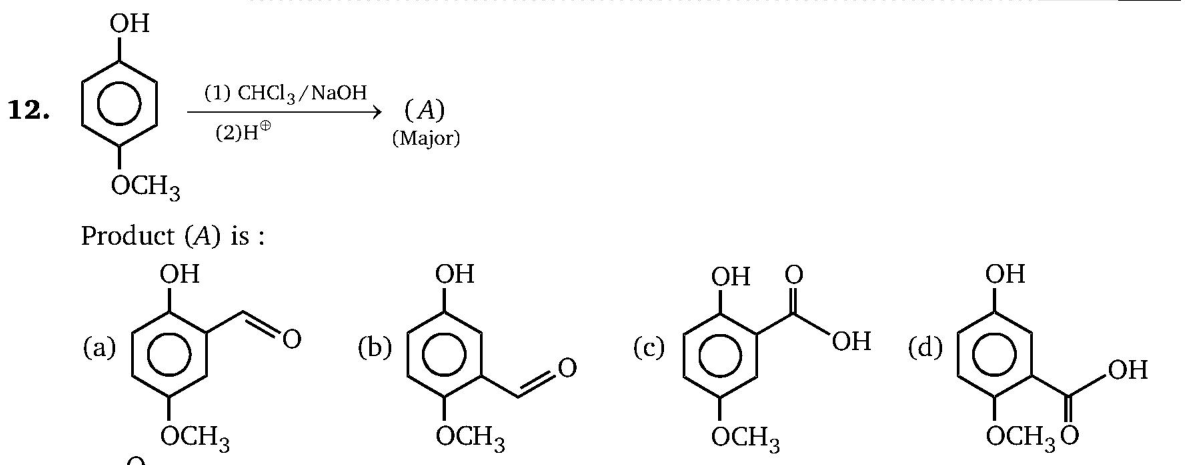
💡 Solution & Explanation
Concept: The Reimer-Tiemann reaction involves treatment of a phenol with CHCl3 and NaOH (aqueous base), followed by acidic workup. The mechanism proceeds via generation of dichlorocarbene (:CCl2) from CHCl3 and NaOH, which then attacks the activated (electron-rich) positions of the phenoxide anion. The electrophilic dichlorocarbene preferentially attacks the ortho position of the phenoxide (ortho attack is favored over para due to steric and electronic factors in the intermediate), forming a dichloromethyl intermediate that upon hydrolysis gives an aldehyde (CHO) group. Step 1: 4-methoxyphenol reacts with NaOH to form 4-methoxyphenoxide anion. The phenoxide oxygen activates the ring at ortho and para positions. Step 2: CHCl3 + NaOH generates dichlorocarbene (:CCl2), a strong electrophile. Step 3: :CCl2 attacks the ortho position relative to the OH group. In 4-methoxyphenol, the para position is already occupied by OCH3, so the major attack occurs at the ortho position (C2 relative to OH, i.e., between OH at C1 and OCH3 at C4). Step 4: The resulting dichloromethyl intermediate (-CHCl2 attached at ortho carbon) undergoes base hydrolysis and then acid workup (H+) to give the aldehyde (-CHO). Result: The major product is 2-hydroxy-4-methoxybenzaldehyde, which is the structure in option (a): a benzene ring with OH at C1, CHO at C2 (ortho to OH), and OCH3 at C4. This is also known as isovanillin's isomer or specifically 3-methoxy-6-hydroxybenzaldehyde - commonly the product is 2-hydroxy-4-methoxybenzaldehyde. Why other options fail: - Option (b): Shows CHO at a different position (para to OH or meta arrangement), which is not the major Reimer-Tiemann product when para is blocked. - Option (c): Shows a carboxylic acid (COOH) group; the Reimer-Tiemann reaction gives aldehydes, not carboxylic acids under these conditions. - Option (d): Also shows a carboxylic acid derivative, which is not consistent with the Reimer-Tiemann reaction mechanism. Therefore, the correct answer is A.