See image — Hydrocarbons Chemistry Question
Question
See image
💡 Solution & Explanation
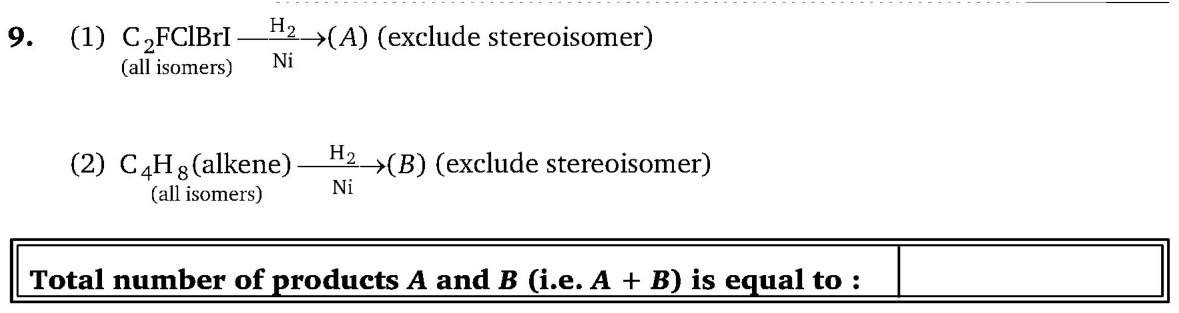
Step 1: Analyze reaction (1) - C2FClBrI with H2/Ni (hydrogenolysis/hydrogenation context). Here C2FClBrI represents a two-carbon compound with one F, one Cl, one Br, and one I substituent total on two carbons, formula C2H(x)FClBrI. Since the formula C2FClBrI implies a dihalocarbon framework, we interpret this as all structural isomers of C2FClBrI (saturated, two carbons with F, Cl, Br, I distributed on the two carbons). The two carbon atoms must collectively bear F, Cl, Br, I plus enough H to satisfy valence. Total substituents on 2 carbons (each tetravalent): we have 4 halogens (F, Cl, Br, I) for 2 carbons giving 8 bonding slots minus 2 for C-C bond = 6 remaining; with 4 halogens that leaves 2 H atoms, so formula is C2H2FClBrI. The possible structural isomers (ignoring stereoisomers) are based on how the 4 halogens are distributed between C1 and C2: distributions are (4,0), (3,1), (2,2). (4,0): one carbon bears all 4 halogens - impossible since carbon is tetravalent and already has C-C bond, so max 3 halogens on one carbon. (3,1): C1 has 3 halogens and C2 has 1 halogen plus 2H. Choosing 3 from {F,Cl,Br,I} for C1 gives C(4,3)=4 ways (leaving out F, or Cl, or Br, or I on C2). Each gives a distinct structural isomer since the single halogen on C2 differs. That gives 4 isomers. (2,2): C1 has 2 halogens, C2 has 2 halogens, each with 1H. Number of ways to split 4 halogens into 2+2 = C(4,2)/2 = 3 (dividing by 2 because C1 and C2 are distinguishable only if we consider the molecule - but actually since the two carbons are different once substituted differently, we get C(4,2)=6 but pairs {AB|CD} and {CD|AB} represent the same compound only if the molecule is symmetric, which here means same set on both carbons. C(4,2)=6 ordered, but {F,Cl on C1, Br,I on C2} is different from {Br,I on C1, F,Cl on C2} only if we can distinguish C1 from C2 - since each carbon has different substituents in asymmetric cases they are the same compound. So unique combinations = C(4,2)/2 = 3). Total structural isomers of C2H2FClBrI = 4 + 3 = 7. Upon hydrogenation with H2/Ni, all halogens are replaced? No - H2/Ni does not typically remove halogens; this reaction replaces the C-X bonds... Actually, re-reading: H2/Ni can hydrogenolyze C-halogen bonds replacing halogens with H. All halogens are removed giving C2H6 (ethane) as the only product regardless of which isomer. So A = 1 product (ethane). Step 2: Analyze reaction (2) - C4H8 alkene isomers with H2/Ni. All structural isomers of C4H8 that are alkenes (excluding stereoisomers): 1-butene (CH2=CHCH2CH3), 2-butene (CH3CH=CHCH3), isobutylene/2-methylpropene ((CH3)2C=CH2), cyclobutane is not an alkene, methylcyclopropane is a cycloalkane not alkene - wait, C4H8 cyclic compounds: cyclobutane and methylcyclopropane are cycloalkanes with formula C4H8 but these are not alkenes. The alkene isomers of C4H8 are: 1-butene, 2-butene (cis and trans, but excluding stereoisomers = 1 compound), 2-methylpropene. That gives 3 alkene structural isomers. Upon hydrogenation: 1-butene -> butane, 2-butene -> butane, 2-methylpropene -> 2-methylpropane (isobutane). So products B: butane (n-butane) and 2-methylpropane (isobutane) = 2 distinct products. But wait - if we also include cyclic C4H8 alkenes... cyclobutene (a cyclic alkene, C4H6 - no, cyclobutene is C4H6). Actually methylenecyclopropane is C4H6 too. The cyclic C4H8 structures with a double bond: there are none that are simple monocyclic alkenes with formula C4H8 other than what's listed, since cyclopentene would be C5H8. So B = 2 products (n-butane and isobutane). Hmm, that gives A+B = 1+2 = 3, not 5. Step 3: Reconsider. Perhaps H2/Ni here means only one equivalent of H2 is added (hydrogenation of double bond only, not hydrogenolysis of halogens). For reaction (1), adding H2 across C=C... but C2FClBrI may contain a double bond. If C2FClBrI is a two-carbon compound with a double bond: C2FClBrI with degree of unsaturation = 1 (double bond), formula C2FClBrI means exactly F,Cl,Br,I on two carbons with a double bond. Each carbon in C=C has 2 remaining bonds. So one carbon has 2 of the 4 halogens and the other has the remaining 2. The isomers: distribution of {F,Cl,Br,I} as 2+2 on each carbon of the double bond. Unique isomers (excluding stereoisomers): {F,Cl}={Br,I}, {F,Br}={Cl,I}, {F,I}={Cl,Br} - since the two carbons of a double bond are distinguishable (different substituents) but {AB|CD} vs {CD|AB} - if both carbons have different pairs they are the same compound (just flip). So 3 structural isomers. Upon adding H2: each gives CHFCl-CHBrI type products. Products A from each isomer: (a) CHFCl-CHBrI, (b) CHFBr-CHClI, (c) CHFI-CHClBr. These are 3 distinct constitutional products (excluding stereoisomers). So A = 3. Step 4: For B, C4H8 alkene isomers -> hydrogenation products. Structural isomers of C4H8 alkenes (excluding stereoisomers): 1-butene, 2-butene, 2-methylpropene = 3 alkenes. Products: 1-butene -> n-butane, 2-butene -> n-butane, 2-methylpropene -> isobutane. Distinct products B = 2 (n-butane, isobutane). Step 5: A + B = 3 + 2 = 5. This matches the given answer. Therefore, the correct answer is A + B = 5.