See image — Alcohols Phenols and Ethers Chemistry Question
Question
See image
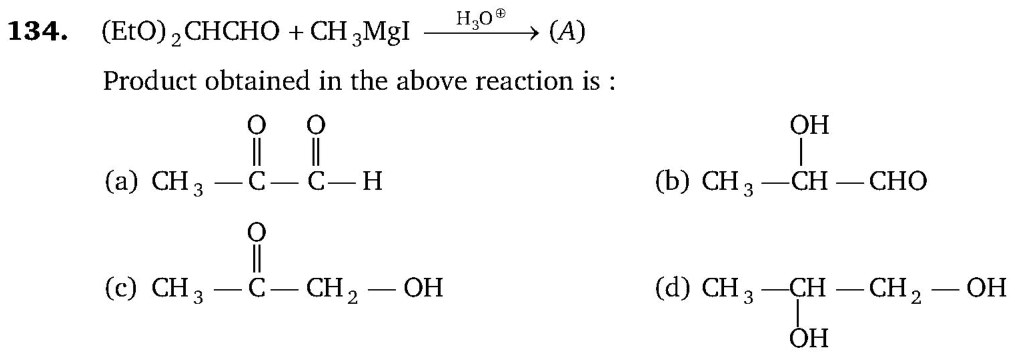
💡 Solution & Explanation
Concept: Grignard reagents act as nucleophiles, adding to carbonyl groups (aldehydes, ketones, esters, etc.). The reagent CH3MgI provides a methyl carbanion (CH3-) that attacks electrophilic carbonyl carbons. Step 1: Identify the substrate. (EtO)2CHCHO is diethyl acetal of glyoxal — more precisely, it is 2,2-diethoxyacetaldehyde. The molecule has two functional groups: an aldehyde (-CHO) and an acetal group (-CH(OEt)2). Under normal Grignard conditions (before aqueous workup), the acetal group is not reactive toward Grignard reagents because acetals are stable under basic/neutral conditions. Only the aldehyde carbonyl is electrophilic and susceptible to nucleophilic addition. Step 2: Reaction of CH3MgI with the aldehyde group. The methyl carbanion attacks the carbonyl carbon of the CHO group: (EtO)2CH-CHO + CH3MgI → (EtO)2CH-CH(OMgI)-CH3 Step 3: Aqueous workup (H3O+). The magnesium alkoxide intermediate is protonated to give the alcohol. Additionally, under acidic aqueous conditions (H3O+), the acetal group (EtO)2CH- hydrolyzes to give an aldehyde (-CHO): (EtO)2CH-CH(OH)-CH3 --H3O+--> OHC-CH(OH)-CH3 This gives: CH3-CH(OH)-CHO, which is lactaldehyde (2-hydroxypropanal). Step 4: Match to options. CH3-CH(OH)-CHO corresponds exactly to option (b). Why other options fail: - Option (a) CH3-CO-CHO (methylglyoxal): This would require oxidation, not addition. - Option (c) CH3-CO-CH2OH: This implies a different connectivity and oxidation state not consistent with Grignard addition followed by acetal hydrolysis. - Option (d) CH3-CH(OH)-CH2OH (1,2-propanediol): This would require reduction of the aldehyde after acetal hydrolysis, which does not occur under these conditions. Therefore, the correct answer is B.