See image — Aldehydes Ketones and Carboxylic Acids Chemistry Question
Question
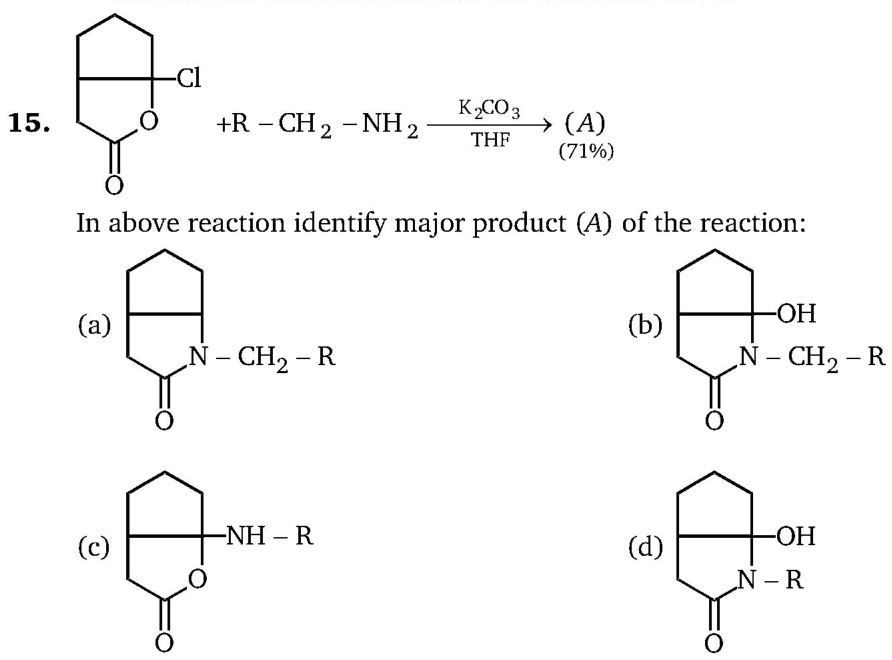
See image
💡 Solution & Explanation
Step 1 - Identify the starting material: The starting material is 1-chloro-1-oxaspiro[2.5]octan-2-one (or equivalently, a spiro compound consisting of a cyclohexane ring fused at a spiro carbon with a beta-lactone ring, where the spiro carbon also bears a chlorine atom). The key features are: (i) a strained beta-lactone (four-membered lactone ring), (ii) a chlorine on the spiro carbon adjacent to the lactone carbonyl, (iii) a cyclohexane ring. Step 2 - Identify the reagent: R-CH2-NH2 is a primary amine. K2CO3 in THF acts as a mild base. Step 3 - Reaction pathway: Primary amines are good nucleophiles. There are two electrophilic sites: the chlorine-bearing spiro carbon (SN2 at C-Cl) and the carbonyl of the beta-lactone (nucleophilic acyl substitution / ring opening). The beta-lactone is highly strained and very reactive toward nucleophiles. The amine (R-CH2-NH2) attacks the carbonyl carbon of the beta-lactone, opening the ring. This releases the alkoxide/oxygen anion at the spiro carbon. After ring opening of the beta-lactone by the amine at the carbonyl, the nitrogen is now attached to the former carbonyl carbon and the oxygen bears a negative charge at the spiro carbon (now an alkoxide). Step 4 - Cyclization: The alkoxide (now an OH after protonation, or still as an oxyanion) at the spiro carbon is adjacent to the nitrogen. The chlorine is still on the spiro carbon. With K2CO3 as base, the nitrogen (after attacking the carbonyl and now having one hydrogen left if it was a primary amine, or the nitrogen being positioned correctly) undergoes intramolecular SN2 displacement of chloride on the spiro carbon, forming a new C-N bond and generating a lactam ring. This produces a spiro lactam where: the spiro carbon now bears an OH (from the former lactone oxygen) and is bonded to N (from the amine), the nitrogen also bears the -CH2-R group, and the C=O is the former lactone carbonyl now as the amide. Step 5 - Product structure: The product is a 2-azaspiro[4.5]decan-2-one (spiro lactam) where: the spiro carbon has an OH group (quaternary carbon with OH), the nitrogen has N-CH2-R substitution, and there is a C=O (lactam carbonyl). This matches option (b). Step 6 - Why other options fail: - (a): Same ring system as (b) but lacks the OH on the spiro carbon. The spiro carbon retains its OH from the opened lactone oxygen, so (a) is wrong. - (c): This retains the lactone ring intact with only N-H substitution on the spiro carbon via simple SN2 on C-Cl, without lactone opening. The strained beta-lactone would preferentially react with the amine at the carbonyl, so (c) is not the major product. - (d): Has N-R instead of N-CH2-R; since the amine used is R-CH2-NH2, the nitrogen retains the full CH2-R group, making (d) incorrect. Therefore, the correct answer is B.