See image — Aldehydes Ketones and Carboxylic Acids Chemistry Question
Question
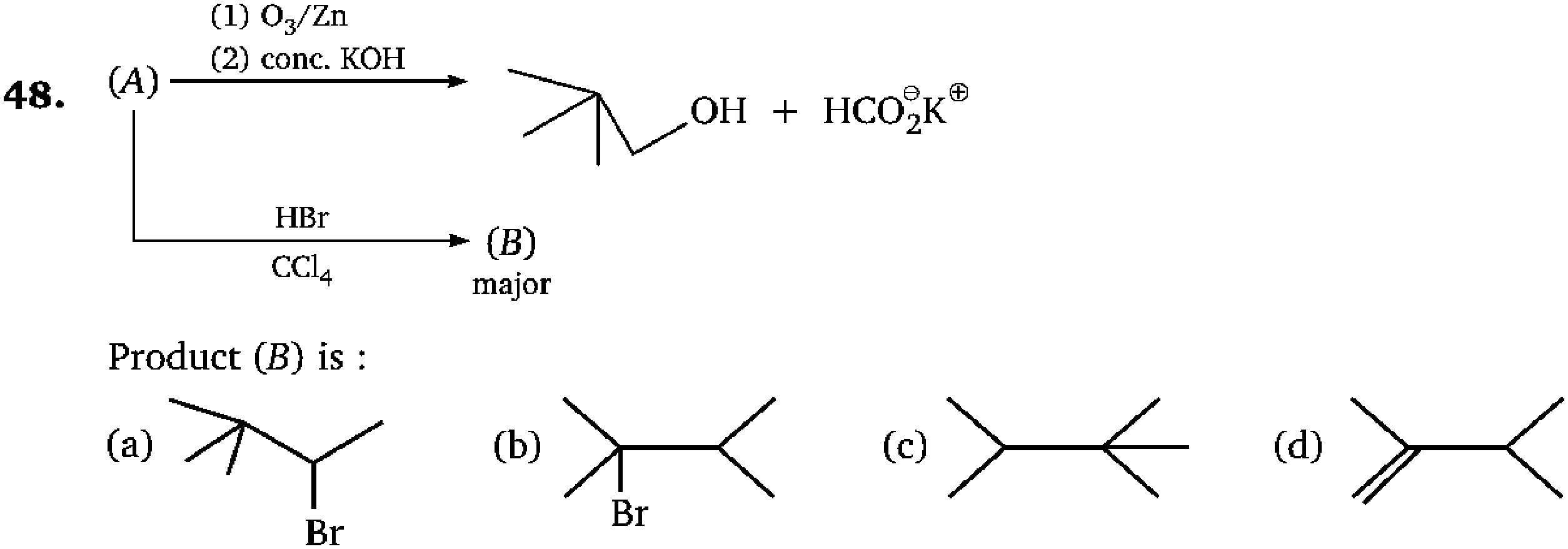
See image
💡 Solution & Explanation
Step 1 – Identify compound (A) from the ozonolysis data. Ozonolysis (O3/Zn) cleaves a C=C double bond into two carbonyl fragments; subsequent treatment with conc. KOH (alkaline workup) converts aldehydes to carboxylate salts and ketones/aldehydes remain or are further processed. The products are 2,2-dimethyl-1-propanol (neopentyl-type fragment, actually shown as (CH3)2C(CH3)-CH2OH = 2,2-dimethylpropan-1-ol, a neopentyl alcohol) and potassium formate (HCO2K). Step 2 – Deduce the structure of (A). Potassium formate arises from oxidation of formaldehyde (HCHO) under alkaline conditions; formaldehyde comes from a =CH2 terminus. The other fragment, after reductive workup and alkaline treatment, gives 2,2-dimethylpropanal (which under conc. KOH / Cannizzaro-type conditions gives the alcohol 2,2-dimethyl-1-propanol and the formate). This means the two ozonolysis aldehyde fragments are: HCHO (from =CH2) and (CH3)3C-CHO (pivaldehyde, 2,2-dimethylpropanal). Therefore compound (A) is 3,3-dimethyl-1-butene: (CH3)3C-CH=CH2. Step 3 – React (A) with HBr in CCl4 (electrophilic addition, Markovnikov's rule). Compound (A) = (CH3)3C-CH=CH2. Protonation of the terminal =CH2 gives the more stable carbocation at the internal carbon: (CH3)3C-CH(+)-CH3. However, this secondary carbocation is adjacent to the tert-butyl quaternary carbon and can undergo a 1,2-hydride shift (or 1,2-methyl shift) to give the more stable tertiary carbocation: (CH3)2C(+)-CH(CH3)-CH3... More precisely: initial Markovnikov addition places H on CH2 and the carbocation on the internal CH, giving (CH3)3C-C(+)H-CH3 (a secondary carbocation). A 1,2-hydride shift from the adjacent quaternary carbon converts this to (CH3)2C(+)-CH(CH3)-CH3... wait, let us reconsider: (CH3)3C-C+H-CH3. The adjacent carbon is C(CH3)3; a hydride shift from that quaternary carbon gives (CH3)2C+-CH(CH3)-CH3, i.e. a tertiary carbocation at what was the tert-butyl carbon. Bromide then attacks this tertiary carbocation to give (CH3)2CBr-CH(CH3)-CH3, which is 2-bromo-2,3-dimethylbutane. Step 4 – Match with options. Option (b) shows the bromine on the more substituted (tertiary) carbon with the connectivity (CH3)2CBr-CH(CH3)2, which is 2-bromo-2,3-dimethylbutane. This is the major product via rearrangement to the more stable tertiary carbocation. Why other options fail: - (a) shows Br on a secondary carbon without rearrangement – this is the minor (direct Markovnikov) product. - (c) shows the alkane with no bromine – not an addition product. - (d) shows an alkene – not an HBr addition product. Therefore, the correct answer is B.