See image — Aromatic Hydrocarbons Chemistry Question
Question
See image
💡 Solution & Explanation
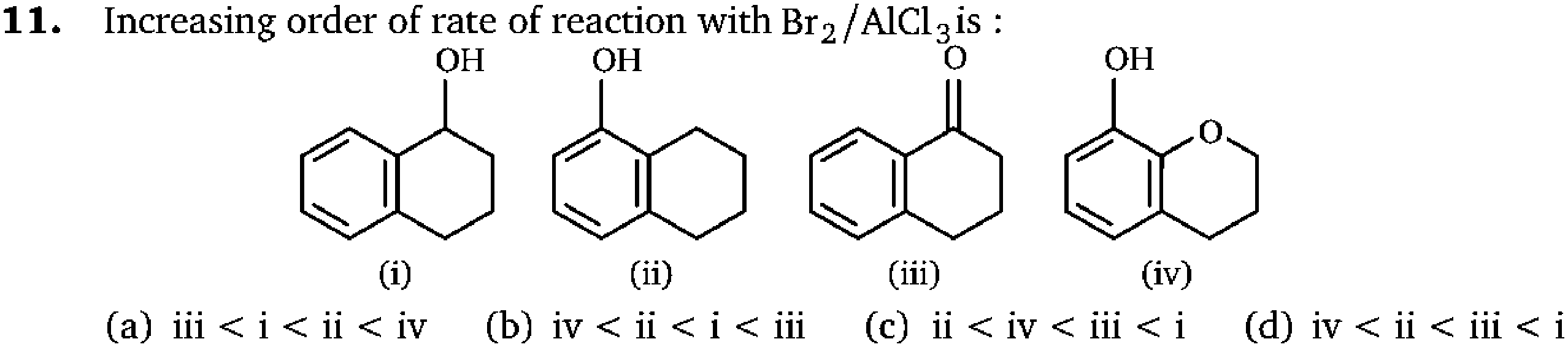
Step 1 - Concept: Br2/AlCl3 is an electrophilic aromatic substitution (EAS) reagent. The rate of EAS depends on the electron density of the aromatic ring. Electron-donating groups (EDG) activate the ring and increase the rate; electron-withdrawing groups (EWG) deactivate the ring and decrease the rate. Step 2 - Analyze each compound: Compound (iii): alpha-tetralone has a carbonyl (C=O) group directly conjugated with the aromatic ring. The carbonyl is a strong EWG by resonance, withdrawing electron density from the ring. This makes the ring the least reactive toward EAS. Rate is lowest. Compound (i): 1-hydroxy tetralin (1-tetralol). The OH is on the sp3 carbon (C1) of the aliphatic ring, NOT directly on the aromatic ring. It does not directly donate electrons to the aromatic ring by resonance. The aliphatic ring fused to benzene provides mild inductive/hyperconjugative effects. The ring is only slightly activated. Compound (ii): 5,6,7,8-tetrahydronaphthalen-1-ol. Here, the OH is directly attached to the aromatic ring at C1 (equivalent to a phenol-type OH on the benzene ring of tetralin). A phenolic OH is a strong EDG by resonance (+M effect), strongly activating the aromatic ring. This gives a higher rate than (i). Compound (iv): chroman-8-ol. In chroman, an oxygen atom is part of the saturated ring (pyran-type oxygen) fused to the benzene ring. This ring oxygen donates electrons to the aromatic ring by resonance (similar to an aryl ether, -OR group on the ring). Additionally, there is an OH substituent at C8 (on the aromatic ring), which is also an EDG. The combination of the ring oxygen (acting as an EDG through the fused ring) and the phenolic OH makes the aromatic ring of chroman-8-ol the most electron-rich and most reactive toward EAS. Step 3 - Order from slowest to fastest (increasing order): - (iii) least reactive (EWG carbonyl deactivates ring) - (i) slightly reactive (OH on sp3 carbon, indirect effect) - (ii) more reactive (phenolic OH directly on aromatic ring, strong EDG) - (iv) most reactive (both ring oxygen and phenolic OH activate the ring strongly) This gives: iii < i < ii < iv, which corresponds to option (a). Step 4 - Why other options fail: - Option (b) places iv as least reactive, which is wrong since iv has two activating oxygens. - Option (c) places ii as least reactive, which contradicts the strong activation by phenolic OH. - Option (d) places iv as least reactive and i as most reactive, which is incorrect. Therefore, the correct answer is A.