See image — Alcohols Phenols and Ethers Chemistry Question
Question
See image
💡 Solution & Explanation
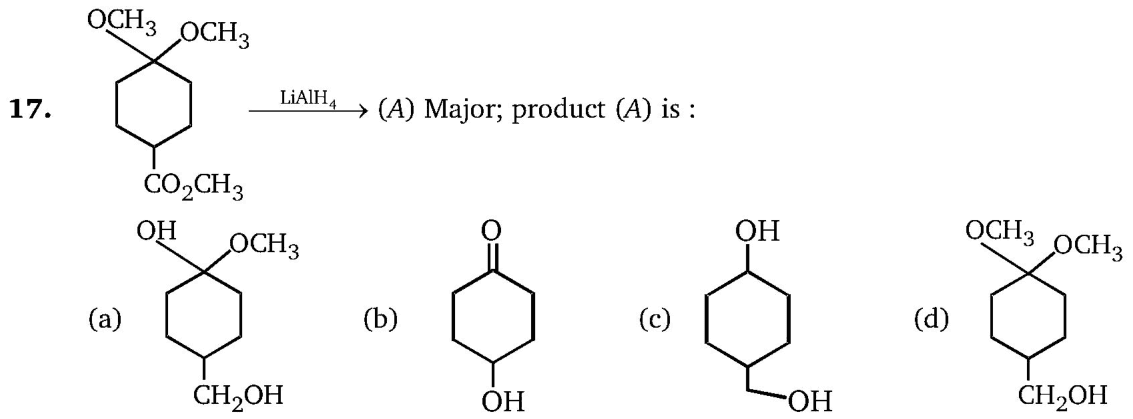
Step 1 - Identify the functional groups in the starting material: The substrate is 1,1-dimethoxycyclohexane-4-carboxylic acid methyl ester. It contains (i) a ketal (acetal) at C1: two OCH3 groups on the same sp3 carbon, and (ii) a methyl ester (CO2CH3) at C4. Step 2 - Reactivity of LiAlH4 toward each group: LiAlH4 is a strong hydride reducing agent. It readily reduces esters (CO2CH3) to primary alcohols (CH2OH). Crucially, LiAlH4 does NOT cleave acetals/ketals under normal conditions because acetals are not electrophilic enough for hydride attack; they require acid catalysis for hydrolysis. The ketal at C1 (the gem-dimethoxy group) is therefore left intact. Step 3 - Predict the product: The ester at C4 is reduced to CH2OH. The ketal at C1 remains as two OCH3 groups on the quaternary carbon. This gives a product with the cyclohexane ring bearing two OCH3 groups at C1 and a CH2OH group at C4. Step 4 - Match to options: Option (d) shows exactly this: cyclohexane ring with OCH3 and OCH3 at C1 (quaternary gem-dimethoxy carbon) and CH2OH at C4. This is the major product. Step 5 - Why other options fail: - Option (a): Shows partial hydrolysis of the ketal to give one OH and one OCH3 at C1, which would require acidic conditions, not LiAlH4. - Option (b): Shows a ketone product, which would require oxidation or hydrolysis rather than reduction. - Option (c): Shows complete hydrolysis of the ketal to give a free OH at C1 plus CH2OH at C4, which again requires acid hydrolysis, not LiAlH4 reduction. Therefore, the correct answer is D.