See image — Isomerism and Stereochemistry Chemistry Question
Question
See image
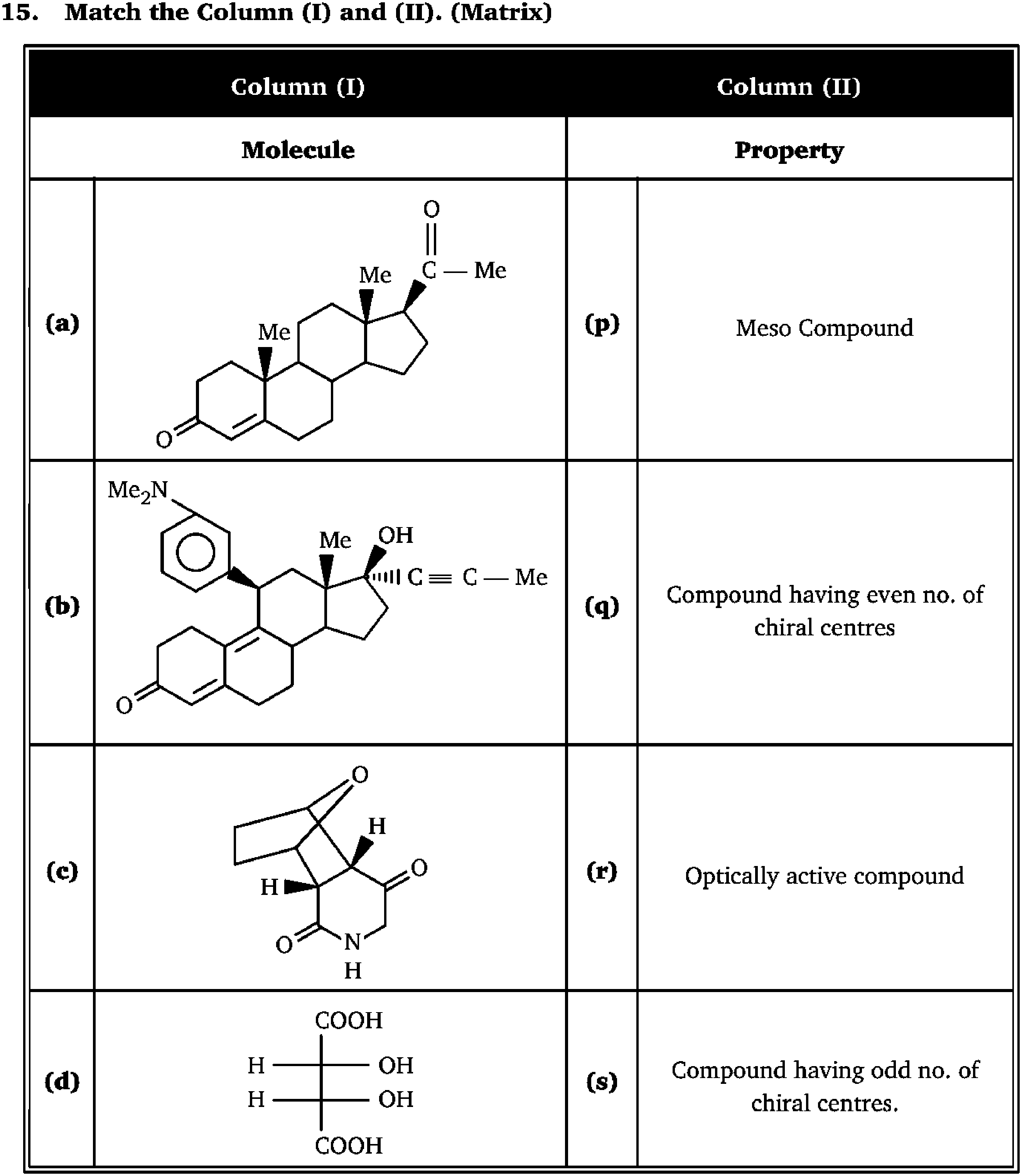
💡 Solution & Explanation
Step 1 – Analyze molecule (a): Progesterone (or similar steroid). Steroids of this type (progesterone) have 6 chiral centres (C5, C8, C9, C10, C13, C14, C17 region — typically counted as 6). Six is an even number, so (q) applies. The molecule is optically active (no internal mirror plane), so (r) also applies. It is not meso (p) and does not have an odd number of chiral centres, so (s) does not apply. Hence a → q, r. Step 2 – Analyze molecule (b): Mifepristone-like steroid. The aromatic B-ring removes two chiral centres compared to fully saturated steroids. Counting the stereocentres: C8 (bold bond at junction with aromatic ring), C13 (bold bond, angular Me), C17 (dashed wedge, OH and alkynyl group) — the structure has approximately 5 chiral centres (an odd number). The compound is optically active (no internal mirror plane present). Hence (r) for optically active and (s) for odd number of chiral centres. Hence b → r, s. Step 3 – Analyze molecule (c): The bicyclic/tricyclic cage lactam with two carbonyls and an NH. Examining the ring junction hydrogens shown on wedge/dash, this compound has an even number of chiral centres. Because of the cage symmetry the molecule can still be optically active (it is not a meso compound — the two ring junction H atoms shown suggest a specific configuration that does not produce an internal mirror plane). Hence (q) even chiral centres and (r) optically active. Hence c → q, r. Step 4 – Analyze molecule (d): The structure drawn is meso-tartaric acid (2,3-dihydroxybutanedioic acid) with both OH groups drawn on the same side (both pointing right in the Fischer projection: H on left, OH on right for both carbons). In a Fischer projection with identical top and bottom halves and opposite configurations at C2 and C3, this is the meso form. Meso tartaric acid has 2 chiral centres (even number) but possesses an internal plane of symmetry making it optically inactive. Hence (p) meso compound and (q) even number of chiral centres. Hence d → p, q. Summary of why other options fail: - (a) is not meso (no internal mirror plane in progesterone), not odd chiral centres. - (b) is not meso, not even chiral centres. - (c) is not meso, not odd chiral centres. - (d) is not optically active (it is meso), not odd chiral centres. Therefore, the correct answer is a-q,r; b-r,s; c-q,r; d-p,q.