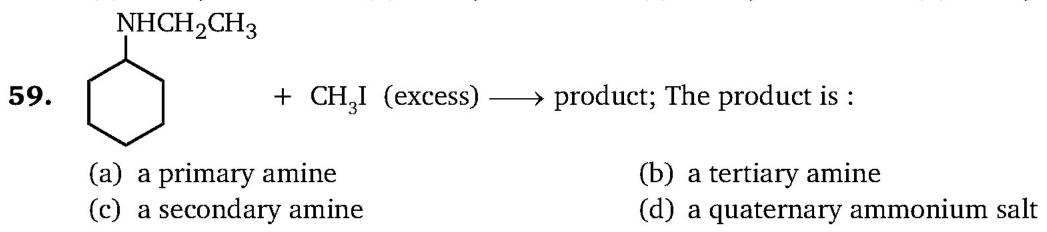
See image — Haloalkanes and Haloarenes Chemistry Question
Question
See image
💡 Solution & Explanation
Concept: Exhaustive methylation of amines with excess alkyl halide (methyl iodide). When an amine is treated with excess CH3I, each available lone pair on nitrogen undergoes successive N-alkylation (Menshutkin-type reaction) until no further alkylation is possible or until a quaternary ammonium salt is formed. Step 1: Identify the starting amine. The starting material is N-ethylcyclohexylamine, which has the structure: cyclohexyl group and an ethyl group both attached to the nitrogen, with one N-H remaining. This is a secondary amine (two carbon substituents on nitrogen: cyclohexyl and ethyl, plus one H). Step 2: First equivalent of CH3I reacts with the secondary amine. The nitrogen (secondary amine, R2NH) acts as a nucleophile and attacks CH3I, displacing iodide. This gives a tertiary amine salt, which upon deprotonation gives a tertiary amine: N-methyl-N-ethylcyclohexylamine (cyclohexyl, ethyl, and methyl all on nitrogen, no N-H). However, since CH3I is in excess, the reaction continues. Step 3: Second equivalent of CH3I reacts with the tertiary amine. The tertiary amine (R3N) attacks another molecule of CH3I, giving a quaternary ammonium iodide salt: [N(cyclohexyl)(ethyl)(methyl)(methyl)]+ I-, i.e., N,N-dimethyl-N-ethylcyclohexylammonium iodide. A quaternary ammonium salt has four carbon groups on nitrogen and carries a positive charge; it cannot be further alkylated. Step 4: Since excess CH3I is used, the reaction goes all the way to the quaternary ammonium salt stage. Why other options fail: - (a) Primary amine: Alkylation increases substitution; going from secondary to primary is impossible under these conditions. - (b) Tertiary amine: With excess CH3I, the tertiary amine intermediate is further alkylated to the quaternary salt. - (c) Secondary amine: Same reasoning; excess reagent drives the reaction past the secondary and tertiary stages. Therefore, the correct answer is D.