See image — Alcohols Phenols and Ethers Chemistry Question
Question
See image
💡 Solution & Explanation
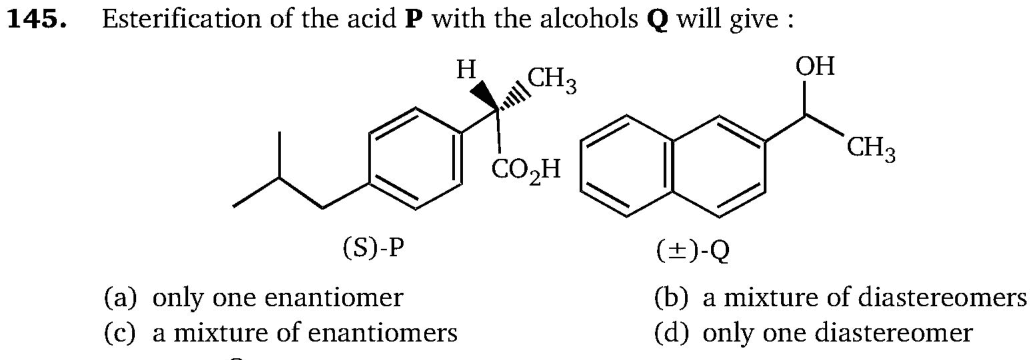
Concept: When a chiral acid reacts with a racemic (±) alcohol, the products are esters formed from each enantiomer of the alcohol combining with the single enantiomer of the acid. Step 1: Identify the stereocenters. - Acid P is a single enantiomer: (S)-configuration at the alpha carbon bearing H, CH3, CO2H, and the 4-isobutylphenyl group. - Alcohol Q is racemic (±): it is 1-(2-naphthyl)ethanol with one stereocenter, existing as both (R) and (S) forms in equal amounts. Step 2: Determine the number of stereocenters in the ester products. - When (S)-P reacts with (R)-Q, the ester product has two stereocenters: (S) from the acid portion and (R) from the alcohol portion → one diastereomer. - When (S)-P reacts with (S)-Q, the ester product has two stereocenters: (S) from the acid portion and (S) from the alcohol portion → another diastereomer. Step 3: Relationship between the two products. - The two products (S,R)-ester and (S,S)-ester are diastereomers of each other (they differ at the alcohol-derived stereocenter but share the same (S) configuration at the acid-derived stereocenter). They are NOT enantiomers because enantiomers would require inversion at ALL stereocenters. Step 4: Conclusion. - The reaction of one enantiomer of a chiral acid with a racemic chiral alcohol produces a mixture of two diastereomers. Why other options fail: - (a) Only one enantiomer: Incorrect; two distinct stereoisomers are formed. - (c) A mixture of enantiomers: Incorrect; the two products share the (S) center from the acid and differ only at the alcohol center, making them diastereomers, not enantiomers. - (d) Only one diastereomer: Incorrect; both enantiomers of the racemic alcohol react, giving two diastereomeric esters. Therefore, the correct answer is B.