See image — Hydrocarbons Chemistry Question
Question
See image
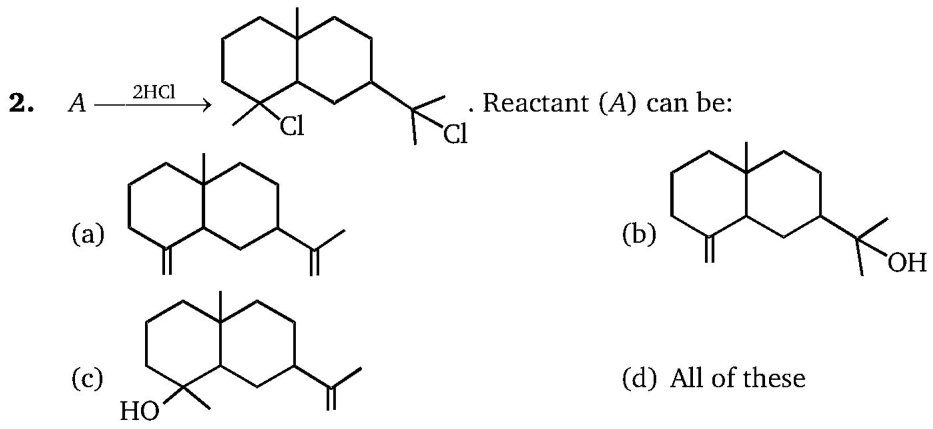
💡 Solution & Explanation
Concept: Addition of HCl to alkenes (Markovnikov addition) and substitution/elimination reactions involving tertiary alcohols with HCl. The product contains two C-Cl bonds: 1. A tertiary chloride at the ring junction carbon bearing two methyl groups (gem-dimethyl at bridgehead) 2. A tertiary chloride on the isopropyl side chain carbon (C(CH3)2Cl) Now analyze each option with 2 equivalents of HCl: Option (a): Has two exo-methylene (terminal alkene, =CH2) groups - one at the ring junction (exocyclic to the bicyclic ring) and one as an isopropenyl group on the side chain. - First HCl adds to the exo-methylene at the ring junction via Markovnikov: H goes to =CH2 (terminal carbon), Cl goes to the more substituted tertiary carbon at the ring junction, giving the gem-dimethyl-Cl at the bridgehead. - Second HCl adds to the isopropenyl group via Markovnikov: H goes to =CH2, Cl goes to the tertiary carbon of the isopropyl chain, giving C(CH3)2Cl. - Both additions give exactly the observed product. ✓ Option (b): Has an exo-methylene at the ring junction and a tertiary alcohol C(CH3)2OH on the side chain. - First HCl adds to exo-methylene (Markovnikov): gives tertiary Cl at ring junction. ✓ - Second HCl reacts with tertiary alcohol via SN1: the tertiary OH is protonated and leaves as water, then Cl- attacks the tertiary carbocation, giving C(CH3)2Cl. ✓ - Both reactions give exactly the observed product. ✓ Option (c): Has a tertiary alcohol HO-C(CH3)2 at the ring junction and an isopropenyl (=CH2) group on the side chain. - First HCl reacts with the tertiary alcohol at the ring junction (SN1): protonation of OH, loss of water gives tertiary carbocation at ring junction, Cl- attacks to give gem-dimethyl-Cl at bridgehead. ✓ - Second HCl adds to the isopropenyl group (Markovnikov): H to =CH2, Cl to tertiary carbon, giving C(CH3)2Cl. ✓ - Both reactions give exactly the observed product. ✓ Since all three options (a), (b), and (c) can react with 2 HCl to give the same product, the answer is (d) All of these. Therefore, the correct answer is D.