See image — Aldehydes Ketones and Carboxylic Acids Chemistry Question
Question
See image
💡 Solution & Explanation
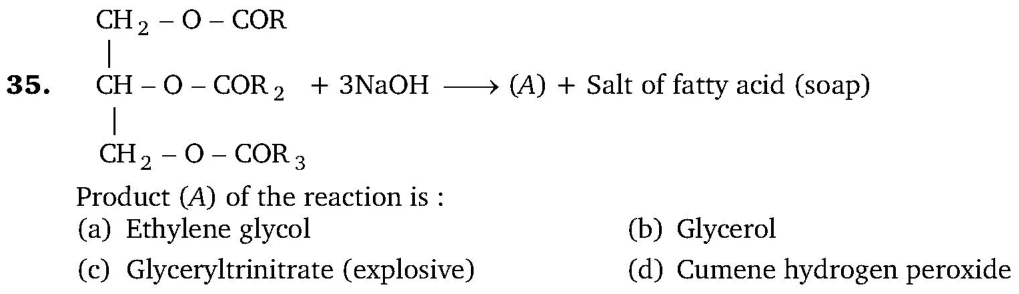
Concept: Saponification is the alkaline hydrolysis of esters, specifically triglycerides (fats and oils), using a strong base like NaOH. Reasoning: The reactant shown is a triglyceride — a glycerol molecule esterified with three fatty acid chains (R, R2, R3 attached via ester linkages -O-COR). When a triglyceride reacts with 3 moles of NaOH, the ester bonds are hydrolyzed. Each ester bond (-O-COR) is cleaved: the fatty acid portions combine with Na+ to form sodium salts of fatty acids (soaps), and the glycerol backbone is released as a free molecule. The glycerol backbone is: CH2(OH)-CH(OH)-CH2(OH), which is glycerol (propane-1,2,3-triol). Step-by-step: 1. Identify the reactant: a triglyceride with three ester bonds. 2. NaOH (3 moles) cleaves all three ester bonds via saponification. 3. Products: 3 moles of soap (RCOONa, R2COONa, R3COONa) + 1 mole of glycerol. 4. Therefore, product (A) = Glycerol. Why other options fail: (a) Ethylene glycol is a diol (2 carbons), not produced from triglyceride hydrolysis. (c) Glyceryltrinitrate is formed by nitration of glycerol with HNO3/H2SO4, not by saponification. (d) Cumene hydrogen peroxide is produced by oxidation of cumene, completely unrelated to this reaction. Therefore, the correct answer is B.