See image — Isomerism and Stereochemistry Chemistry Question
Question
See image
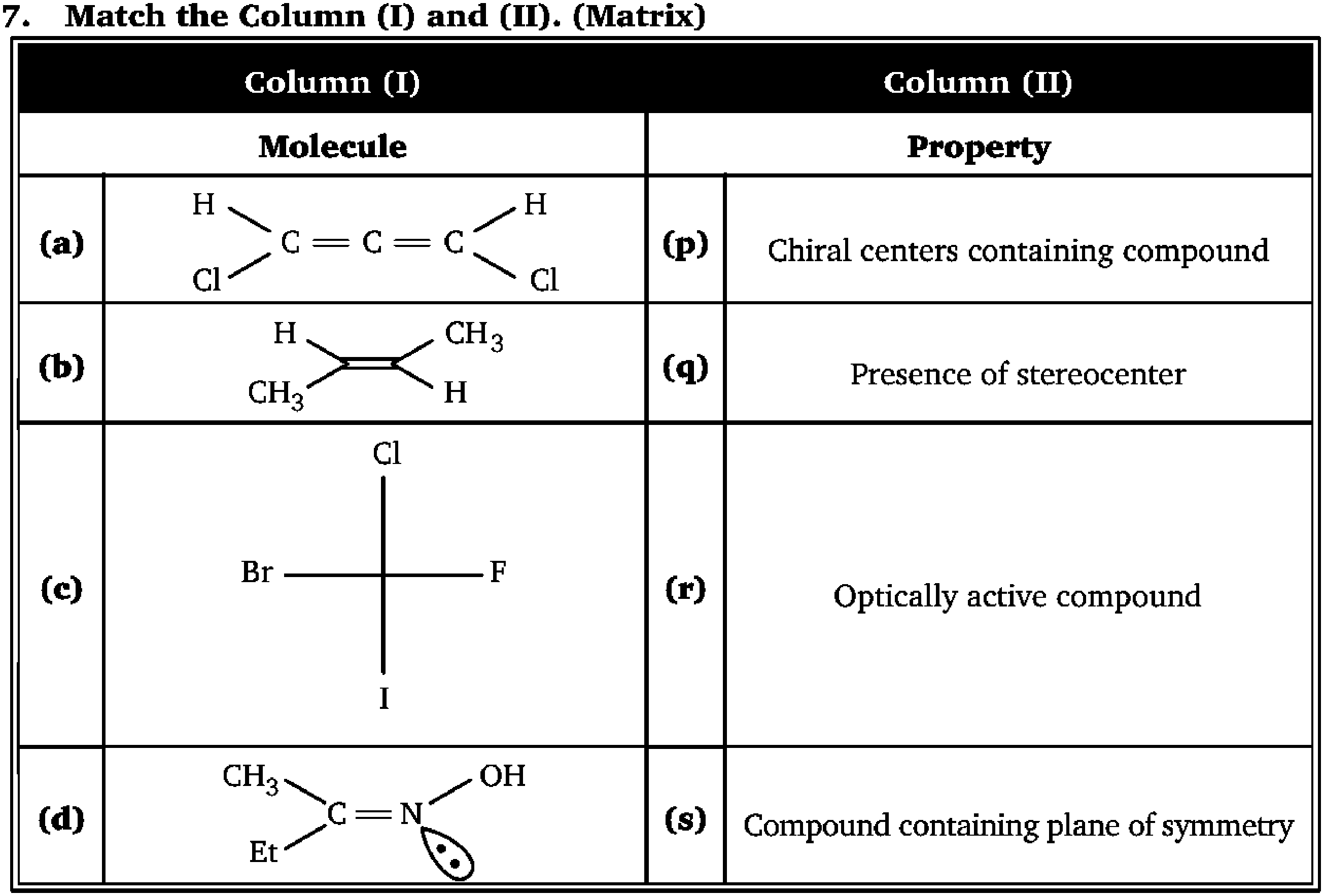
💡 Solution & Explanation
Step 1: Analyze molecule (a) - 1,3-dichloroallene (H,Cl)C=C=C(H,Cl). In allenes, the two end groups are in perpendicular planes. The two terminal carbons each bear H and Cl. Because the substituents on each terminal carbon are different (H ≠ Cl), and the two planes are perpendicular, the molecule is chiral (axial chirality). However, there is NO classical chiral carbon (sp3 carbon with 4 different groups). The central carbon of the allene is a stereocenter (axial stereocenter/stereoaxis). The molecule is optically active (it exists as non-superimposable mirror images). It has a stereocenter (the allenic axis counts as a stereocenter) but no chiral CENTER in the classical sp3 sense. Therefore (a) matches (q) presence of stereocenter and (r) optically active compound. Answer: a → q, r. Step 2: Analyze molecule (b) - trans-2-butene shown in sawhorse projection with H and CH3 on each carbon of the double bond in trans arrangement. The C=C double bond carbons are stereocenters (geometric stereocenters). The molecule is trans-2-butene. It has a plane of symmetry (the plane bisecting the molecule perpendicular to C=C axis, or the molecular plane itself gives symmetry making it achiral). It is NOT optically active. It has stereocenters (the sp2 carbons bearing different groups qualify as stereocenters in the context of E/Z isomerism). It has NO chiral center (no sp3 carbon with 4 different groups). Therefore (b) matches (q) presence of stereocenter and (s) compound containing plane of symmetry. Answer: b → q, s. Step 3: Analyze molecule (c) - Carbon bearing four different substituents: Cl, Br, F, I. This is a classic chiral center: one sp3 carbon bonded to four different atoms/groups. It has a chiral center (p), it has a stereocenter (q), and it is optically active (r) since it has no internal plane of symmetry and the compound (as a single enantiomer) rotates plane-polarized light. Therefore (c) matches (p) chiral centers containing compound, (q) presence of stereocenter, and (r) optically active compound. Answer: c → p, q, r. Step 4: Analyze molecule (d) - Oxime of methyl ethyl ketone: (CH3)(Et)C=N-OH with lone pair on N. The nitrogen in the oxime C=N-OH bears: the C=N bond, OH, and a lone pair. In oximes, N is considered a stereocenter because it has three different groups plus a lone pair (similar to sp3 nitrogen but with restricted inversion due to the C=N double bond). The nitrogen atom in an oxime is a stereocenter (E/Z isomerism at C=N). The molecule can have E and Z forms. The carbon bearing CH3 and Et has only two different groups (plus =N-), so it is not a classical chiral center. However, the N is a stereocenter. The molecule (either E or Z isomer) has a plane of symmetry? Actually for (CH3)(Et)C=N-OH, the two groups on carbon are different (CH3 ≠ Et), giving E/Z isomers, and the nitrogen is the stereocenter. Each isomer (E or Z) has a plane of symmetry within the molecular framework (the plane of the C=N-O system). The molecule is achiral (has plane of symmetry) and not optically active, but has a stereocenter (N). Therefore (d) matches (q) presence of stereocenter and (s) compound containing plane of symmetry. Answer: d → q, s. Therefore, the correct answer is a-q,r; b-q,s; c-p,q,r; d-q,s.