See image — Alcohols Phenols and Ethers Chemistry Question
Question
See image
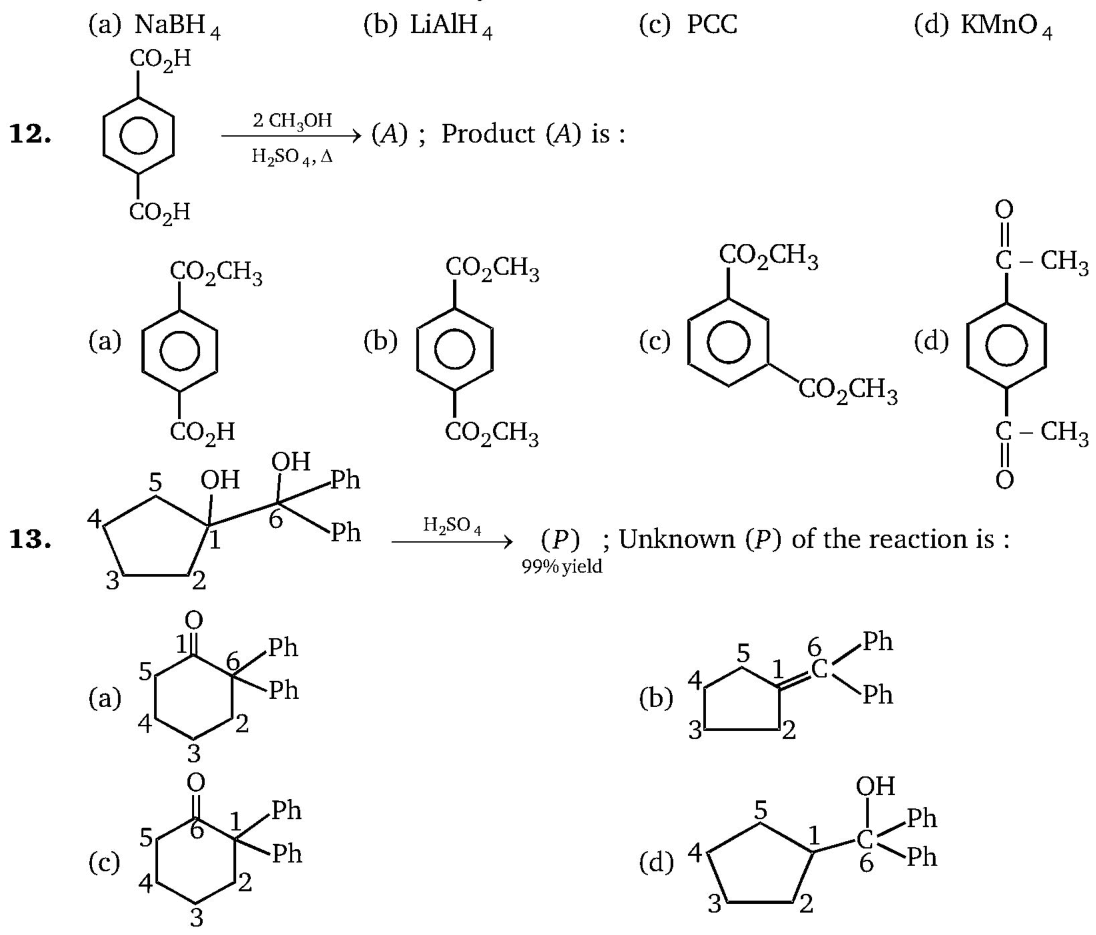
💡 Solution & Explanation
Concept: Acid-catalyzed pinacol-type rearrangement / semipinacol rearrangement. When a 1,2-diol (or a beta-hydroxy carbinol system) is treated with acid, one OH is protonated and leaves as water to form a carbocation, which then undergoes a 1,2-shift (hydride or alkyl/aryl migration) to give a carbonyl compound. Step 1 - Identify the substrate: The starting material is a cyclopentane with C1 bearing an OH group and an exocyclic C6 bearing OH and two phenyl groups. This is a beta-hydroxy tertiary alcohol on a cyclopentane ring — a classic substrate for the semipinacol rearrangement. Step 2 - Protonation and ionization: H2SO4 protonates the tertiary benzylic OH at C6 (the more stabilized position). Loss of water generates a tertiary carbocation at C6, which is stabilized by the two phenyl groups. Step 3 - 1,2-carbon shift (ring expansion): The C1-C2 bond of the cyclopentane (or the C1-C5 bond) migrates to the adjacent carbocation at C6. This ring expansion converts the five-membered ring into a six-membered ring. The C1-C6 bond migrates, expanding the cyclopentane to a cyclohexane ring, placing the positive charge on C1. Step 4 - Loss of proton / formation of carbonyl: C1 now bears the positive charge and still has the OH group. The OH at C1 loses a proton to give a ketone (C=O) at C1 in the newly formed cyclohexane ring, with the two Ph groups remaining on C6. Step 5 - Product: A cyclohexanone ring with the ketone at C1 and two phenyl groups at C6, which corresponds to option (a). Why other options fail: - Option (b): Simple dehydration to give an exocyclic alkene (no ring expansion) would not be the major product under these conditions at 99% yield; moreover, the semipinacol rearrangement is highly favored. - Option (c): Ketone at C6 with Ph,Ph at C1 implies an incorrect regiochemistry of migration. - Option (d): Retention of the starting diol without reaction is inconsistent with H2SO4 treatment. Therefore, the correct answer is A.