See image — Alcohols Phenols and Ethers Chemistry Question
Question
See image
💡 Solution & Explanation
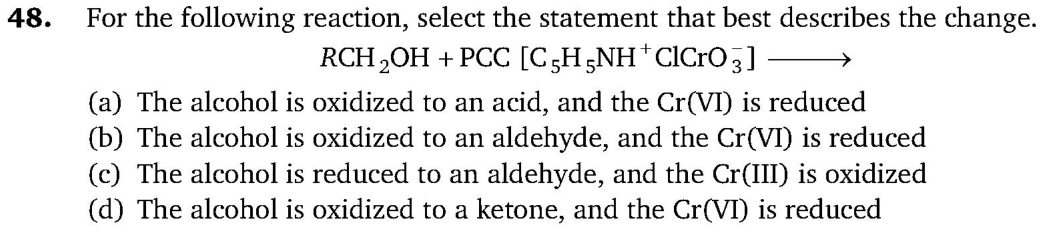
Step 1 - Identify the reagent: PCC stands for Pyridinium Chlorochromate, represented as [C5H5NH+ClCrO3-]. It is a mild oxidizing agent used in organic chemistry. Step 2 - Identify the substrate: RCH2OH is a primary alcohol (the carbon bearing the OH group has two hydrogen atoms attached). Step 3 - Determine the oxidation product: PCC is a mild oxidant that oxidizes primary alcohols only to aldehydes (RCHO), not all the way to carboxylic acids. Stronger oxidants like KMnO4 or K2Cr2O7/H2SO4 would oxidize a primary alcohol to a carboxylic acid. PCC stops at the aldehyde stage because the reaction is performed in anhydrous (non-aqueous) conditions, preventing further oxidation. Step 4 - Determine what happens to chromium: In PCC, chromium is in the +6 oxidation state (Cr(VI) as in ClCrO3-). When it acts as an oxidizing agent, it gains electrons and is reduced to Cr(III). This is consistent with all chromium-based oxidations. Step 5 - Evaluate the options: (a) Incorrect - PCC does not oxidize primary alcohols to carboxylic acids; that requires stronger oxidants. (b) Correct - Primary alcohol RCH2OH is oxidized to aldehyde RCHO, and Cr(VI) is reduced to Cr(III). (c) Incorrect - The alcohol is oxidized (loses hydrogen/electrons), not reduced; also, Cr goes from +6 to +3 (reduction, not oxidation). (d) Incorrect - RCH2OH is a primary alcohol; ketones are formed from secondary alcohols. Therefore, the correct answer is B.