See image — Biomolecules Chemistry Question
Question
See image
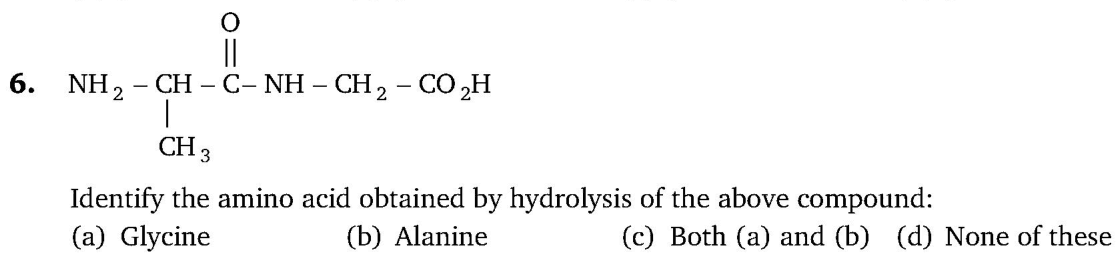
💡 Solution & Explanation
Concept: Hydrolysis of a peptide bond breaks the amide linkage (C(=O)-NH) by addition of water, regenerating the constituent amino acids. Step 1: Identify the peptide bond in the structure. The compound NH2-CH(CH3)-C(=O)-NH-CH2-CO2H contains one peptide bond: the C(=O)-NH linkage between the two residues. Step 2: Hydrolyze the peptide bond. Adding water across the C(=O)-NH bond gives two fragments: - Fragment 1: NH2-CH(CH3)-COOH, which is Alanine (2-aminopropanoic acid, has an alpha-amino group, alpha-carboxyl group, and a methyl side chain). - Fragment 2: NH2-CH2-COOH, which is Glycine (2-aminoacetic acid, has an alpha-amino group and alpha-carboxyl group with no side chain). Step 3: Confirm the identities. - Alanine: NH2-CH(CH3)-COOH ✓ - Glycine: NH2-CH2-COOH ✓ Step 4: Evaluate options. - (a) Glycine only — incomplete, Alanine is also produced. - (b) Alanine only — incomplete, Glycine is also produced. - (c) Both (a) and (b) — correct, both Glycine and Alanine are obtained upon hydrolysis. - (d) None of these — incorrect. Therefore, the correct answer is C.