See image — Alcohols Phenols and Ethers Chemistry Question
Question
See image
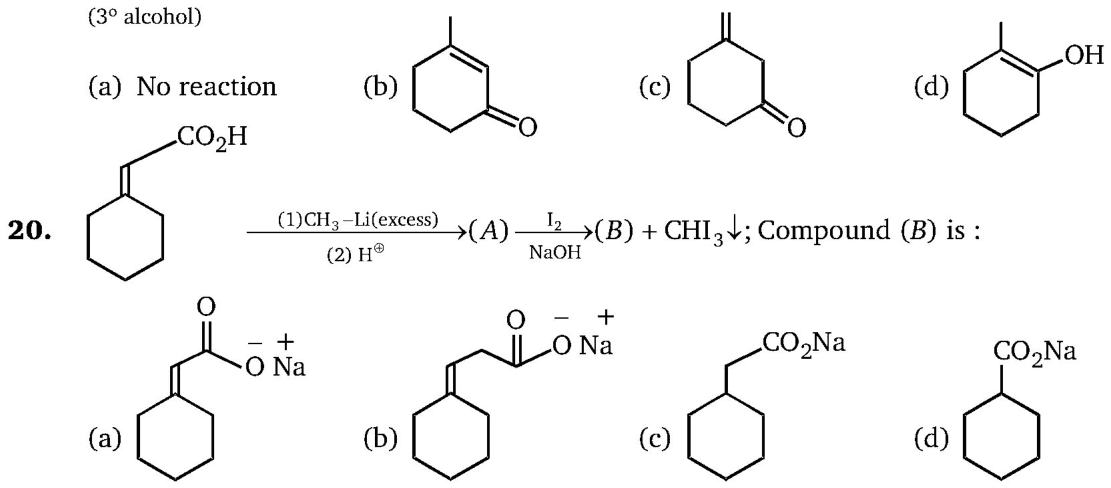
💡 Solution & Explanation
Step 1 - Identify the starting material: The starting material is (cyclohexylidene)acetic acid, which has the structure: cyclohexane=CH-CH2-CO2H (an exocyclic alkene with an acetic acid side chain). Step 2 - Reaction with excess CH3Li then H(+): First equivalent of CH3Li deprotonates the carboxylic acid (CO2H + CH3Li -> CO2(-) Li(+) + CH4). Second equivalent of CH3Li acts as a nucleophile and adds to the carboxylate (the carboxylate becomes a ketone equivalent after workup, i.e., it forms a dianion intermediate). Upon acidic workup (H(+)), the dianion gives a methyl ketone. Specifically, excess organolithium reagent converts a carboxylic acid to a methyl ketone: RCO2H + 2 RLi -> R-CO-CH3 (after hydrolysis). So compound (A) is (cyclohexylidene)acetic acid converted to a methyl ketone: the product is 1-(cyclohexylidene)-2-propanone... more precisely, the acid RCH2CO2H becomes RCH2COCH3. Thus A = (cyclohexylidene)acetone, i.e., the compound: cyclohexane=CH-CH2-CO-CH3 (but actually the starting material is cyclohexylidene-CH2-CO2H, so A = cyclohexylidene-CH2-CO-CH3). Step 3 - Iodoform reaction of A with I2/NaOH: Compound A contains a methyl ketone group (-CO-CH3). The iodoform reaction (I2/NaOH) cleaves methyl ketones: R-CO-CH3 + 3I2 + 4NaOH -> R-COO(-) Na(+) + CHI3 + 3NaI + 3H2O. So the -COCH3 portion is replaced by -COO(-) Na(+), releasing CHI3 (iodoform precipitate). Step 4 - Identify compound B: A = (cyclohexylidene)-CH2-CO-CH3. After iodoform reaction, the COCH3 becomes COO(-) Na(+): B = (cyclohexylidene)-CH2-COO(-) Na(+) = sodium (cyclohexylidene)acetate. This corresponds to option (a): the sodium salt with the structure cyclohexane ring with exocyclic double bond and -CH2COO(-) Na(+). Step 5 - Why other options fail: (b) has an extra CH2 group (propionic acid chain) which is not consistent with the starting material. (c) lacks the exocyclic double bond (shows cyclohexyl-CH2-CO2Na, a saturated system). (d) shows CO2Na directly on the cyclohexane ring without any exocyclic alkene or methylene chain. Therefore, the correct answer is A.