See image — Reaction Mechanism Chemistry Question
Question
See image
💡 Solution & Explanation
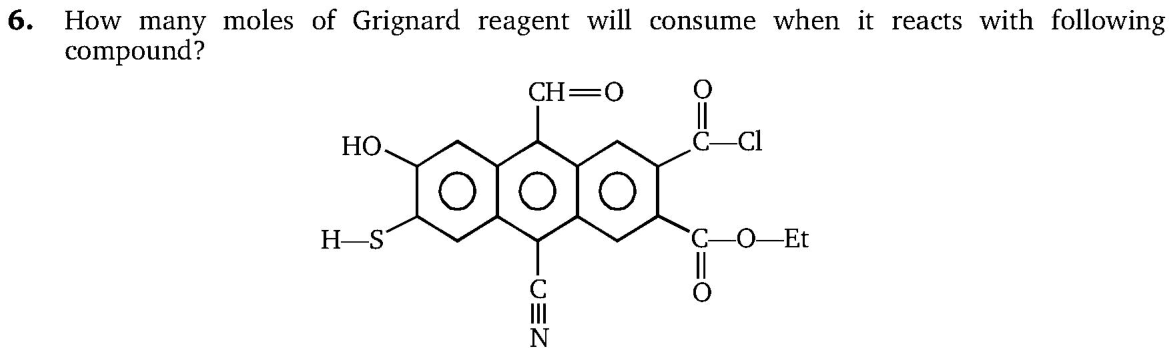
Concept: Grignard reagents (RMgX) are strong nucleophiles and strong bases. They react with various functional groups by either nucleophilic addition or acid-base (proton transfer) reactions. The key is to count ALL moles of Grignard reagent consumed per mole of compound. Step 1: Identify all reactive functional groups in the molecule and how many moles of Grignard reagent each consumes. 1. CHO (Aldehyde): Grignard reagent adds to the carbonyl via nucleophilic addition → consumes 1 mole of RMgX. 2. C(=O)Cl (Acid chloride): Grignard reagent adds to acid chloride. The first addition gives a ketone intermediate, which reacts with a second equivalent of Grignard reagent to give a tertiary alcohol. Thus acid chloride consumes 2 moles of RMgX. 3. HO- (Phenol/Alcohol -OH): Grignard reagent is a strong base and reacts with acidic protons (O-H). The O-H proton is abstracted → consumes 1 mole of RMgX. 4. H-S- (Thiol -SH): Grignard reagent reacts with the acidic S-H proton (thiol is more acidic than alcohol) → consumes 1 mole of RMgX. 5. C≡N (Nitrile): Grignard reagent adds to the nitrile group via nucleophilic addition to give an imine salt (after hydrolysis gives a ketone). This consumes 1 mole of RMgX. 6. C(=O)-O-Et (Ester): Grignard reagent adds to the ester. The first addition expels the ethoxy group to give a ketone intermediate, which immediately reacts with a second equivalent of Grignard reagent to give a tertiary alcohol. Thus ester consumes 2 moles of RMgX. Step 2: Sum all moles consumed: - Aldehyde: 1 - Acid chloride: 2 - Hydroxyl (-OH): 1 - Thiol (-SH): 1 - Nitrile: 1 - Ester: 2 Total = 1 + 2 + 1 + 1 + 1 + 2 = 8 moles of Grignard reagent. Step 3: Verify no groups are missed or miscounted. All six functional groups are accounted for, and the acid chloride and ester each consume 2 equivalents due to double addition, giving a total of 8. Therefore, the correct answer is 8.