See image — Reaction Mechanism Chemistry Question
Question
See image
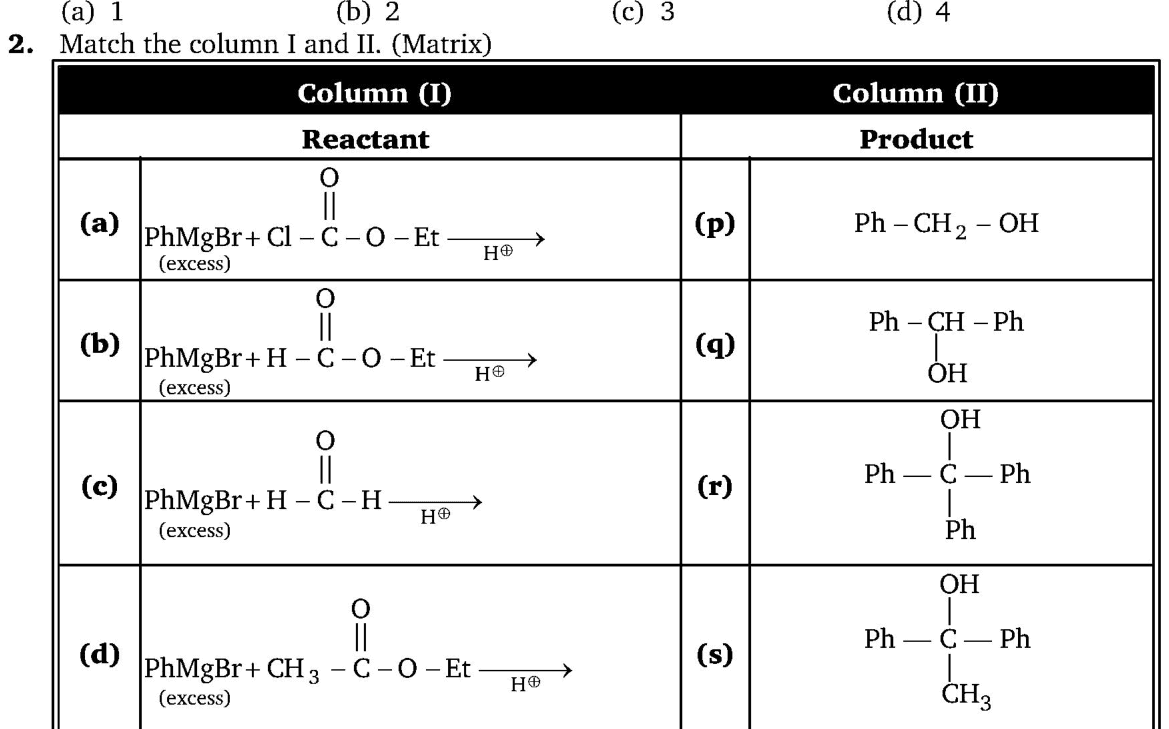
💡 Solution & Explanation
Step 1 - General concept: Grignard reagents (RMgBr) are strong nucleophiles that add to carbonyl compounds. When used in excess with esters or acyl chlorides, the first addition gives a ketone/aldehyde intermediate which reacts with a second equivalent of Grignard reagent. Formate esters and formaldehyde are special cases. Step 2 - Analysis of each reactant: (a) PhMgBr (excess) + Cl-C(=O)-OEt (ethyl chloroformate / chloroformate ester): Acyl chlorides react with Grignard reagents. The first equivalent of PhMgBr attacks the carbonyl carbon of Cl-C(=O)-OEt. After loss of Cl- (or OEt-), a benzophenone-type intermediate (Ph-C(=O)-OEt or directly benzaldehyde equivalent) is formed, but actually with an acyl chloride the intermediate is a ketone Ph-C(=O)-Ph... Wait, let me reconsider. Cl-C(=O)-OEt is ethyl chloroformate. First PhMgBr adds to give Ph-C(=O)-OEt (ethyl benzoate) after loss of Cl-, then a second PhMgBr adds to ethyl benzoate to give Ph-C(=O)-Ph (benzophenone) intermediate, then a third PhMgBr adds to give Ph3C-OH (triphenylmethanol) after workup. With excess PhMgBr: product is triphenylmethanol = (r). (b) PhMgBr (excess) + H-C(=O)-OEt (ethyl formate): First equivalent of PhMgBr adds to the formate ester carbonyl: H-C(=O)-OEt + PhMgBr --> intermediate --> after loss of OEt-, gives benzaldehyde (Ph-CHO). Second equivalent of PhMgBr adds to benzaldehyde to give Ph-CH(OMgBr)-Ph, after workup gives Ph-CH(OH)-Ph (benzhydrol) = (q). (c) PhMgBr (excess) + H-C(=O)-H (formaldehyde): Formaldehyde has no leaving group, so only one addition occurs per carbonyl. PhMgBr + HCHO --> Ph-CH2-OMgBr --> after workup Ph-CH2-OH (benzyl alcohol) = (p). Even with excess PhMgBr, there is no second carbonyl to attack after the first addition to formaldehyde. (d) PhMgBr (excess) + CH3-C(=O)-OEt (ethyl acetate): First equivalent of PhMgBr adds to ethyl acetate: CH3-C(=O)-OEt + PhMgBr --> CH3-C(=O)-Ph (acetophenone) intermediate after loss of OEt-. Second equivalent of PhMgBr adds to acetophenone: CH3-C(=O)-Ph + PhMgBr --> CH3-C(OMgBr)(Ph)-Ph --> after workup gives Ph-C(OH)(Ph)-CH3 (1,1-diphenylethanol) = (s). Step 3 - Matching summary: (a) --> (r): triphenylmethanol (b) --> (q): benzhydrol (c) --> (p): benzyl alcohol (d) --> (s): 1,1-diphenylethanol Therefore, the correct answer is {"a": ["R"], "b": ["Q"], "c": ["P"], "d": ["S"]}.