See image — Amines Chemistry Question
Question
See image
💡 Solution & Explanation
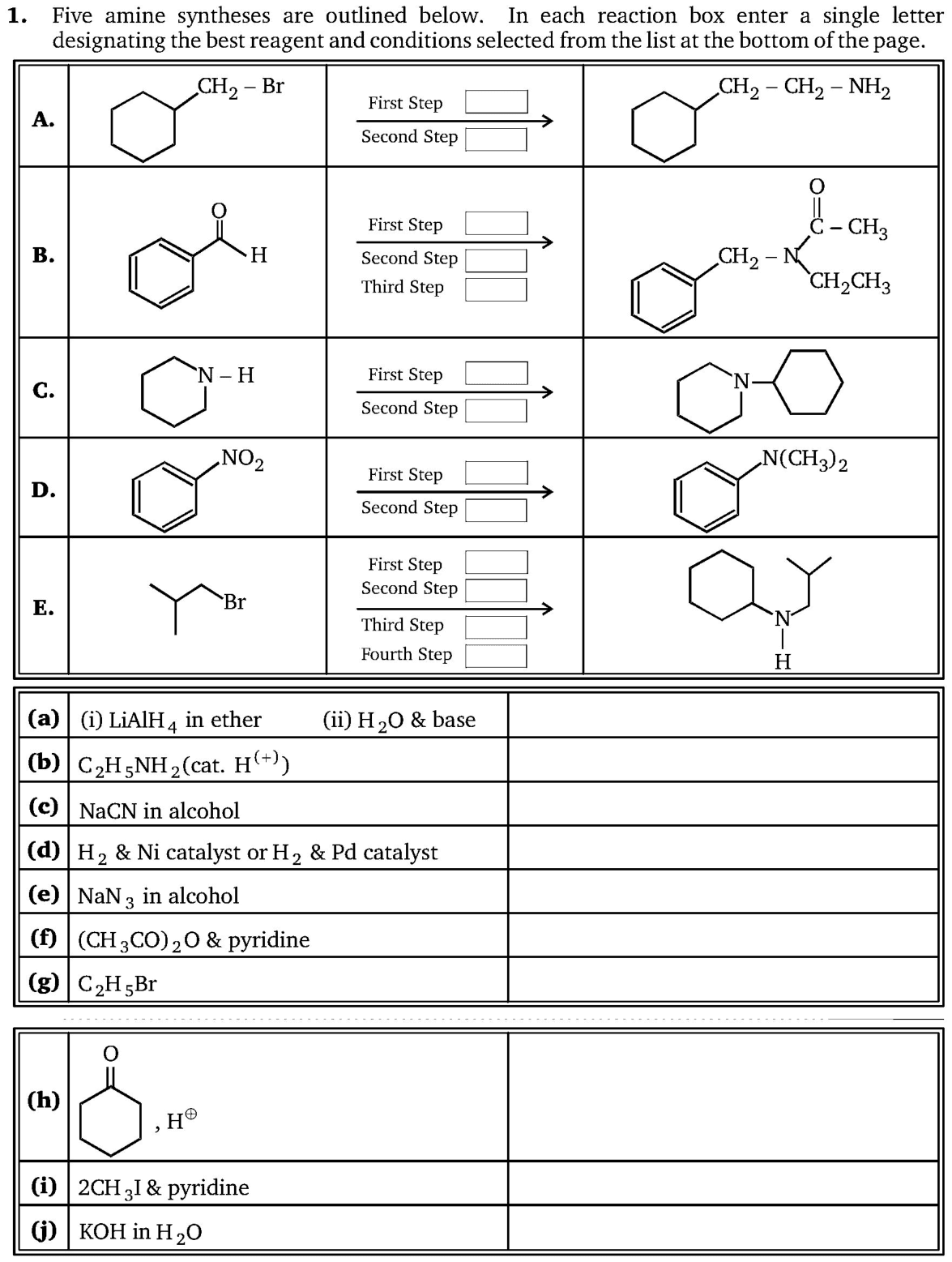
We analyze each synthesis in turn: **Reaction A: cyclohexyl-CH2Br → cyclohexyl-CH2-CH2-NH2** The product has one more carbon than the starting alkyl bromide, and terminates in a primary amine. Strategy: SN2 with NaCN (reagent c) converts the alkyl bromide to a nitrile (cyclohexyl-CH2-CN), extending the chain by one carbon. Then LiAlH4 reduction (reagent a) reduces the nitrile to a primary amine (cyclohexyl-CH2-CH2-NH2). Alternatively, NaN3 (reagent e) gives an azide, but that does not extend the chain; so for chain extension we need NaCN. The nitrile can also be reduced by H2/Ni or H2/Pd (reagent d). Hence: First Step = c (NaCN), Second Step = a (LiAlH4) or d (H2/catalyst). Answer: c, a or c, d. **Reaction B: benzaldehyde (PhCHO) → Ph-CH2-N(C2H5)(COCH3)** The product is N-benzyl-N-ethylacetamide. Strategy: - Step 1: Reductive amination of benzaldehyde with ethylamine (reagent b: C2H5NH2, cat. H+) followed by hydrogenation (reagent d) gives Ph-CH2-NH-C2H5 (N-benzylethylamine). Actually reagent b includes the acid catalyst for imine formation, and reagent d reduces the imine to the amine. So First Step = b (form imine/iminium with C2H5NH2), Second Step = d (H2 reduction to give Ph-CH2-NH-CH2CH3). - Step 3: Acylation of the secondary amine with acetic anhydride/pyridine (reagent f) gives Ph-CH2-N(C2H5)(COCH3). Answer: b, d, f. **Reaction C: piperidine (N-H) → 1-cyclohexylpiperidine** The product is piperidine with a cyclohexyl group on nitrogen. Strategy: reductive amination. First react piperidine (secondary amine) with cyclohexanone under acid (reagent h: cyclohexanone, H+) to form an iminium ion, then reduce with H2/catalyst (reagent d) to give the tertiary amine. Answer: h, d. **Reaction D: nitrobenzene → N,N-dimethylaniline** Strategy: - Step 1: Reduce nitrobenzene to aniline using H2/Ni or H2/Pd (reagent d). - Step 2: Methylate aniline twice with 2CH3I/pyridine (reagent i) to give N,N-dimethylaniline. Alternatively, Step 1 could use LiAlH4 (reagent a) to reduce nitrobenzene to aniline, then Step 2 = i. Both pathways give the same result. Answer: d, i or a, i. **Reaction E: isobutyl bromide → N-isobutylcyclohexylamine** The product is a secondary amine: cyclohexyl-NH-CH2CH(CH3)2. The starting material is isobutyl bromide. Strategy: - Step 1: Convert isobutyl bromide to isobutyl azide using NaN3 (reagent e). - Step 2: Reduce azide to isobutylamine (primary amine) using LiAlH4 (reagent a): (CH3)2CHCH2-NH2. - Step 3: Reductive amination with cyclohexanone under acid (reagent h: cyclohexanone, H+) forms an iminium ion between isobutylamine and cyclohexanone. - Step 4: Reduce the iminium with LiAlH4 or H2 (reagent a) to give cyclohexyl-NH-CH2CH(CH3)2. Answer: e, a, h, a. Therefore, the correct answer is {"A": "c, a or c, d", "B": "b, d, f", "C": "h, d", "D": "d, i or a, i", "E": "e, a, h, a"}.